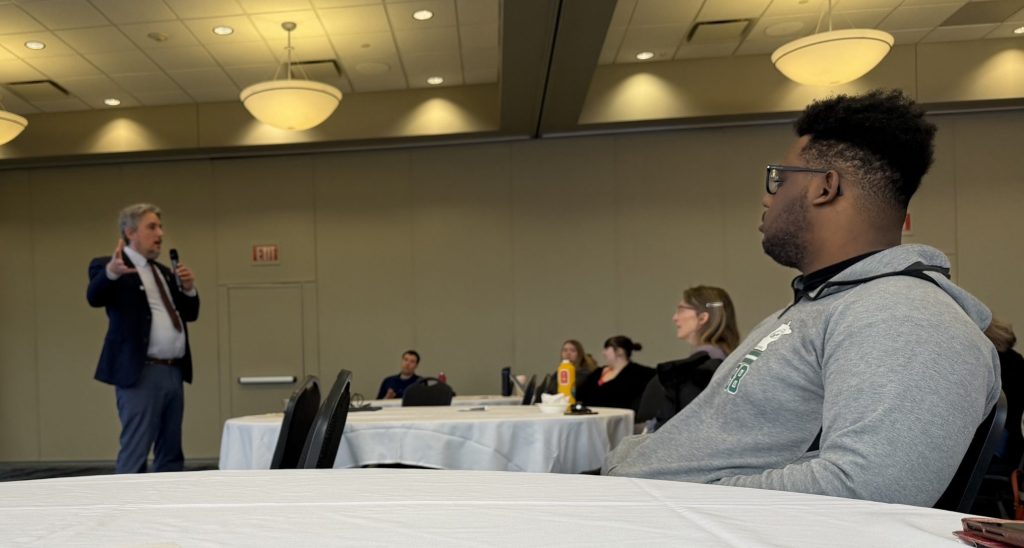
Graduating students face a more complex job market; one that is becoming increasingly automated.
What jobs are most likely to be affected?
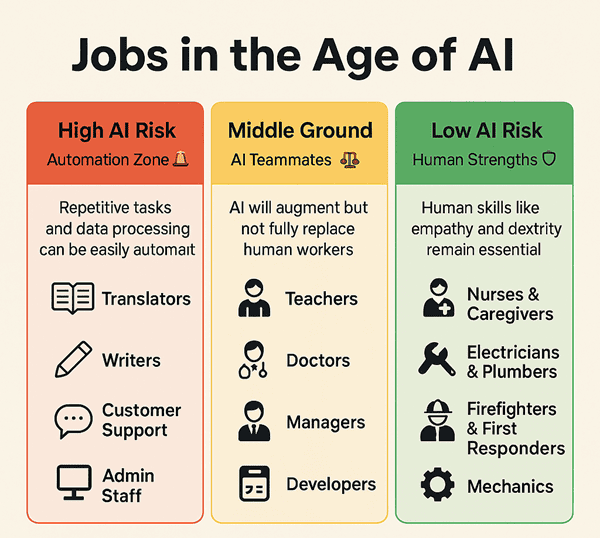
AI is being implemented across all types of job fields, creating fears of job replacement for graduating students of all majors. The Bureau of Labor Statistics finds job fields are projected to decline in hiring the most by 2034 are administrative support, payroll, and customer service representatives who are likely to be replaced by infamous AI chatbots. Data entry keyers are projected to be the most affected over the next decade, expected to reduce jobs by 28%.
Artist and writer employment is being greatly affected already with the recent rise of generative AI use. A study conducted by Forbes found that almost 30% of creative jobs in this field could be completely automated, leaving this industry with one of the highest levels of job insecurity among careers today.
Computer programmers also may face some cuts, with an existing 20% reduction in hiring since 2022 according to a Stanford Study. Working alongside AI in this field is becoming more common as well, with the implementation of AI programs that are designed to increase efficiency and eliminate certain tasks for the humans working in programming roles, but even this creates a shift in the required skills needed for graduating students.
“I actually am a little scared of the rise of AI. I overheard a customer at my job say he doesn’t hire anyone who isn’t proficient in AI,” says Communications senior Nealy Martin-Thomas. “Graphic design isn’t my major, but I know that can just be put into AI to create graphics, same with a lot of things in PR.”
Studies show positive trends with AI in the workplace.
Not every job field is expected to be so negatively affected. The BLS also found that some industries are expected to “grow at an above average rate”, a promising sign for students of certain fields. For example, nurse practitioners and data scientists’ fields are expected to grow by between 30-40% by 2034.
Students entering the medical field have much less to worry about when it comes to AI replacement. Medical professions include roles that are much more hands on and require complex judgement, leadership, and unpredictable problem solving and are among the least likely to be automated.
“Physical therapy isn’t going to be taken over by AI any time soon, if ever,” PT student Ashley Fielder says. “Automation isn’t really a fear of mine and I can really appreciate that.”
These fields are more likely to experience augmentation with AI, rather than full automation. The difference between augmentation and automation is an important one: with automation, jobs are replaced entirely by AI, whereas with augmentation, AI is simply implemented and works alongside real people to increase efficiency. A number of job fields are looking more toward a human-AI collaborative work style rather than complete replacement, a comforting sentiment for many students soon expected to graduate.
Careers experiencing augmentation are largely the ones that are expected to experience growth over the next decade, says Harvard Business School Professor, Suraj Srinivasan. “I’m not that afraid of AI, honestly. There’s just so many things it can’t do, at least yet.” says Communications senior Jess Vargas. “I feel like it can’t replace us entirely.”
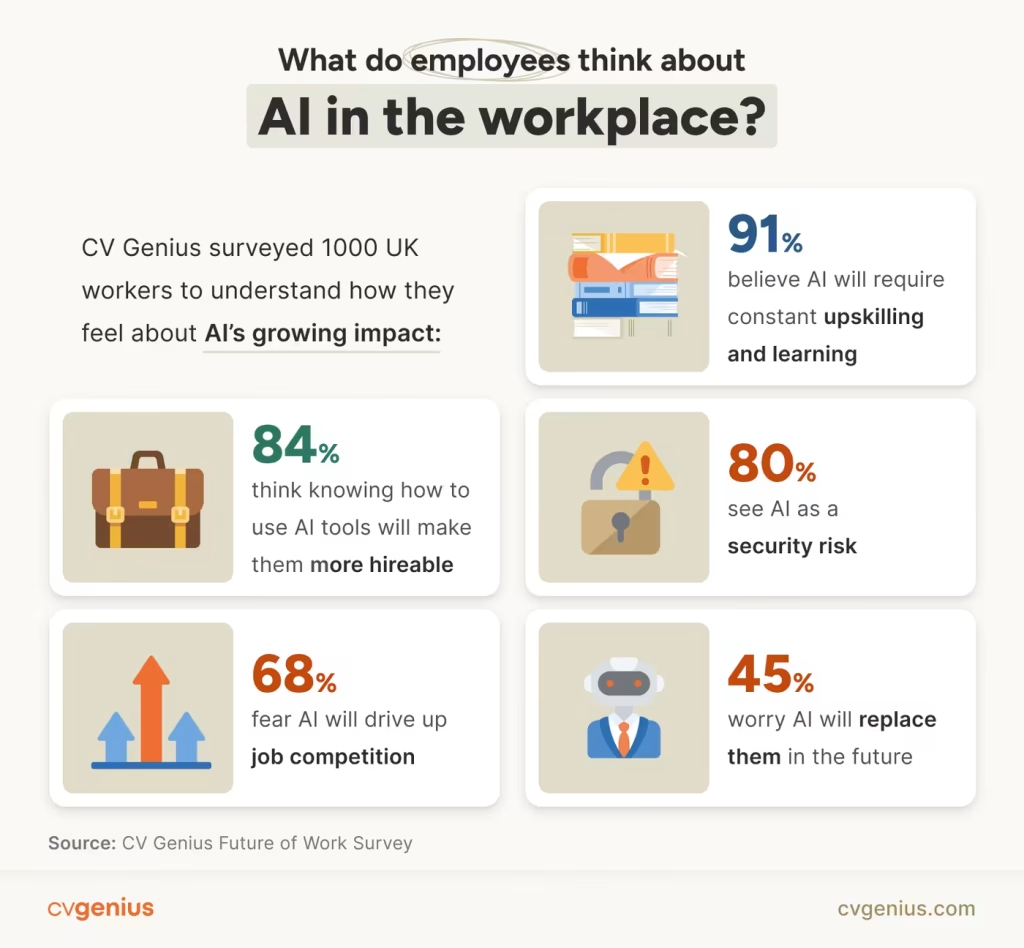
Replacing real people with AI has become a more popular practice because of the low labor cost and perceived convenience. Workers who have begun to work alongside AI feel generally positive about it, AIPRM found that 90% of workers who work with AI say it helps them save time on tasks and users report that it saves them an average of 2.2 hours per week. However, they also found that 30% of workers fear AI replacing them entirely over the next 10 years.
An article by Jeffrey Seligno in New York Magazine highlights some skills that graduating students can hone that still give them an edge above AI. Selingo suggests focusing in the human-centric skills that AI cannot replace, like emotional intelligence and complex judgement.
“Despite all the grim news, this moment isn’t entirely unfamiliar in higher education,” he says. “In the late 1990s, colleges treated the internet at first as a digital encyclopedia.” From personal experience, Selingo adds that AI in the work force is reminiscent of the introduction of the internet, which ultimately went on to create jobs that no one had predicted. “AI optimists believe the same cycle of jobs lost/jobs created will repeat itself.”
AI is reshaping the work force for everyone and fears of job replacement are not unfounded, but studies and professionals are finding ways to adapt. Focusing in on skills that AI can’t replicate or using AI to the advantage of the human worker have created promising new ways to navigate a changing work force.