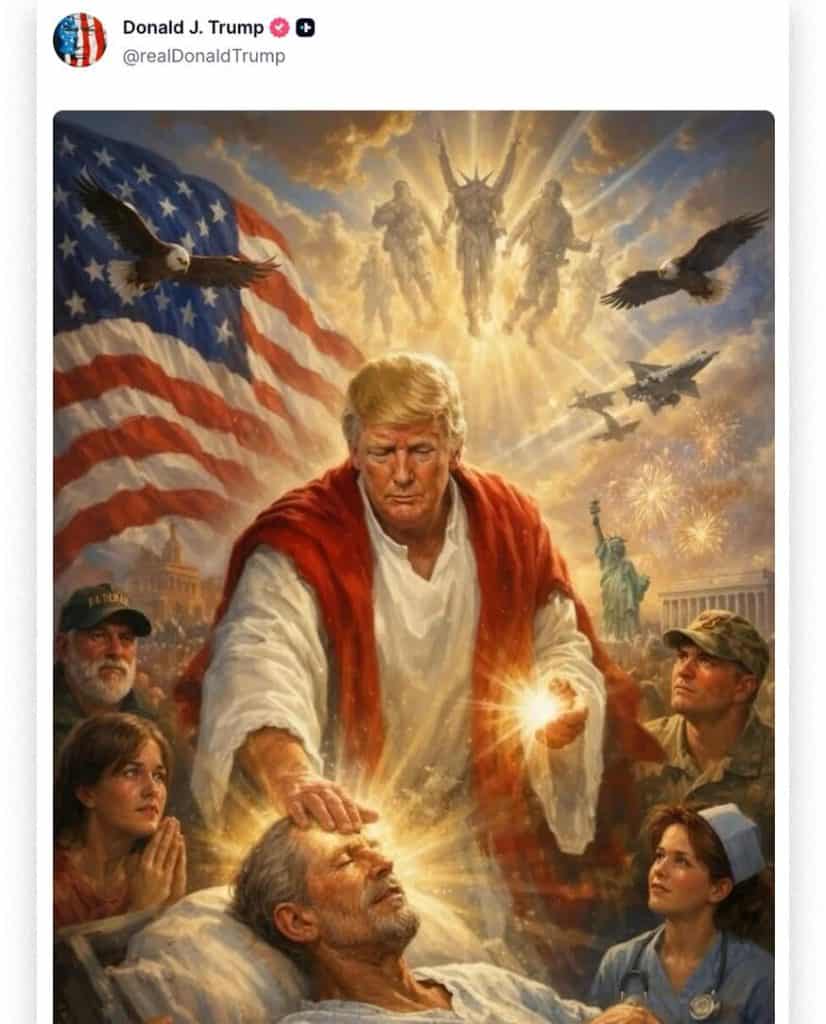
An AI-generated image posted to Truth Social by President Donald Trump, portraying him in a Jesus-like pose, drew criticism before being deleted.
By: George Coin, BuzzStaff Writer
On campus and nationally, President Donald Trump has drawn backlash after posting and subsequently deleting an AI-generated image that many viewers interpreted as portraying him in a Jesus-like way.
At SAU, reactions range from disbelief to exhaustion. Theology, biology, and chemistry major sophomore Rylan Moore, says she felt “a lot of whiplash,” especially because the image arrived near Easter and amid the ongoing war.
“It’s political theater,” Moore adds. “He’s comparing himself to an incomparable being. None of his actions are indicative of somebody who’s really following the way of Christ.”
Theology professor Fr. Robert “Bud” Grant’s reaction to the image is blunt: “It was ugly. It was crude. It was juvenile and completely to be expected.” But Fr. Bud also argues that political use of religious imagery is nothing new. “Rich and powerful people throughout history have used religious imagery to bolster their own reputation,” he says, calling it part of a long tradition of self-promotion.
“I’m a doctor and I make people feel better.”
SAU junior graphic design major Bella Vitale says she is not shocked so much as just tired of it. “Was I surprised? Absolutely not,” she says. “It’s pretty on brand for him at this point.” She says what bothers her is not just the image itself, but what it implies. “He’s depicting himself as this person that he is simply not.”
After posting the image to his Truth Social account, Trump removed it from the website within a matter of hours amid growing criticism. When questioned by reporters, Trump said he thought it was him as a doctor healing people, not as Jesus Christ. “I said, how did they come up with that? It’s supposed to be me as a doctor, making people better, and I do make people better.”
The image has also intensified his public feud with Pope Leo XIV over the pope’s criticism of the war in Iran. Trump has publicly attacked the pope for being “weak on crime” and “terrible for foreign policy.” Pope Leo has repeatedly called for peace and condemned the use of religious rhetoric to justify war.
Junior computer science major Juwan Burns describes Trump’s post as “really confusing, but not really surprising.” He says Trump seems to see himself as “this high figure.” Burns, who says he is not Catholic, believes that more devout Catholics are “probably really offended by it.”
Branding the Divine: Trump Style
What makes the controversy feel bigger on this campus is not just the image itself, but what it suggests about religion being used as political theater and branding. Moore says there is “virtually no reason” for sacred imagery to be used in political self-promotion and that “the risk of offending people is too great.”
Vitale agrees: “If you’re not going to depict yourself respectfully … don’t even touch it. Just don’t.” At a university where Catholic identity is part of the institution’s mission, students repeatedly describe the post as something more serious than a throwaway internet meme.
A Search for “Truth, Reverence, and Humility”
That is also how university president Dr. Amy Novak frames it. Novak says the controversy matters because it touches “sacred imagery, moral authority, and the sacred role of religion in the life of our community.” She argues that at a Catholic university, religious symbols are not merely cultural references but are tied to truths the university holds sacred.
The real question, she says, is whether such imagery deepens “reverence, truth, and humility,” or turns the sacred into “a tool of branding, power, or self-promotion.” Novak adds that a Catholic university should not issue partisan judgments on every controversy, but it does have a responsibility to help students “think well” when issues touch “faith, moral symbolism, human dignity, or the voice of the Church.”
Read Dr. Novak’s complete interview here.
Along similar lines, kinesiology professor Dr. Sarah Eikleberry says she does not think it is automatically the campus’s responsibility to address every controversy “if there’s not a substantial disruption to learning.”
Still, she says the episode should get students’ attention because it shows “so little diplomacy” and offers an example of what leadership should not look like. Her initial reaction is simple and memorable: “Zero points. Ridiculous use of AI.”
She also argues that universities can do something more useful than release statements: they can help students practice actual dialogue. “All of us need to be armed with a better ability to listen,” she said, because people with different views often still share “common truths.”
Pointing to Christ’s example, SAU chaplain Fr. Dale Mallory argues that the better response is calm, serious, and grounded rather than reactive. Fr. Mallory also emphasizes the weight of Jesus’ image in Christian life. “Given that Jesus is the savior and the Son of God in Christianity, the use of Jesus Christ’s image in political discourse of any kind is always going to cause at least some controversy.”
“When that image includes portraying oneself in the role of Jesus, something that most Christians would find offensive, if not blasphemous, then we should not be surprised that many Christians would be upset.” But Mallory urges students to respond calmly and not take the bait. “Our goal should be to engage civilly and without reacting to every single slight,” he says. “While reacting emotionally may feel good in the moment, it rarely does anything to change minds.”
Political Power and Moral Authority
For Fr. Bud, he says the larger issue is not whether faith and politics should mix, but how. “The church has a moral obligation to speak to the ethics of civil society, and that’s political.” In that sense, the clash between Trump and Pope Leo becomes a lesson in the difference between political power and moral authority.
Dr. Novak highlights why SAU teaches students to think critically and morally. She says that Catholic universities are places where students learn to connect “public life with moral judgment.”
Rylan Moore says students should care because when leaders stop reflecting the values they preach, “we have to be able to stand up.” Fr. Bud puts it even more broadly: “We are all in this together.” And that is why a strange AI image posted hundreds of miles away from here became a question about reverence, leadership, and the common good.