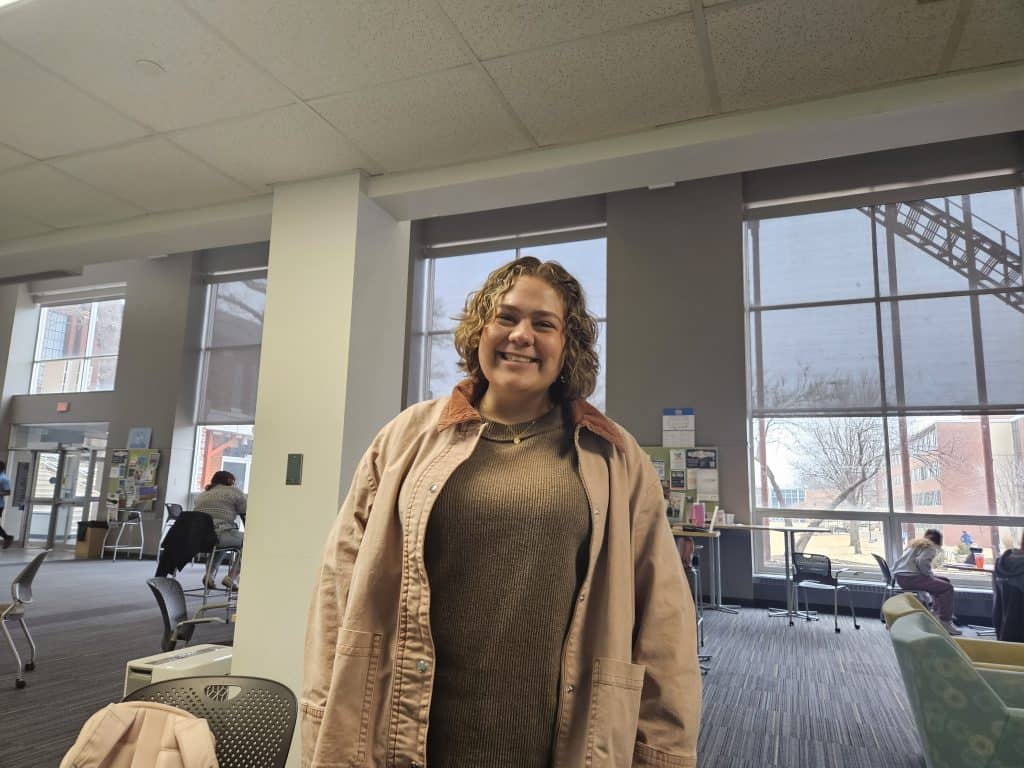
Photo caption: Mallory Zeman is a sophomore majoring in Psychology and Theology and says credit cards can be beneficial when used wisely but dangerous when used impulsively. Photo by George Coin.
Story By: George Coin, Buzz Staff Writer
Credit cards are nearly impossible to avoid on a modern college campus. Credit card companies frame getting a credit card as a rite of passage and a pathway to financial independence for college students. Students are constantly reminded that building credit is part of becoming an adult. But is it a smart financial step or a fast track to debt?
SAU students and faculty say credit cards are risky but can be beneficial. Many express concern that students are not adequately taught about compounding interest or how credit scores work before they are targeted by marketing campaigns.
Mallory Zeman, a sophomore majoring in Psychology and Theology, represents one of the many students who do not own a credit card. “My parents don’t trust me.” She says they worry she might be tempted to overspend.
Their concerns align with national trends. According to the Federal Reserve, U.S. credit card debt recently surpassed $1 trillion, while average interest rates remain historically high. Consumer financial research has shown that young adults are especially vulnerable to carrying revolving balances. This underscores how easy it is to get stuck in a cycle of repayment.
Though Mallory doesn’t own one, she says she believes credit cards can be beneficial when used wisely but dangerous when used impulsively. Zeman notes many students underestimate how quickly interest accrues, especially if they make only minimum payments. She says that without a clear understanding, it is easy to justify small purchases that slowly add up to significant balances.
Chris Loken, a senior studying Computer Science and Cybersecurity, says he views credit cards as a useful but risky tool. He says they require discipline and awareness. While he sees the value in building credit early, he also emphasizes students can easily fall into poor habits if they treat credit as free money rather than borrowed money. Chris adds, “It’s too easy to dig yourself into a hole you can’t dig your way out of.”
International perspectives highlight how culturally specific credit card usage can be. SAU journalism freshman Gyorgy Domonkos says that in Hungary, debit cards are the norm. “In my country, we don’t use credit cards. We use bank cards… you cannot go into a negative balance.” He says he dislikes the idea of spending money that has not yet been earned.
“I don’t like that they allow you to spend money you don’t have,” Domonkos says. He believes credit cards clearly encourage overspending. “Definitely. They give you the chance to spend more money than you actually have.” When asked whether he would ever get one, his answer was simple: “No.”
Freshman Pre-Law student Hannah McNall says she sees credit cards as a way to establish and build credit when handled correctly. However, she points out many students lack the education to manage them wisely. She says she believes that more structured financial literacy education would help students make better decisions before opening accounts.
Sophomore nursing major Ashton Wesley describes her relationship with credit cards as “pretty good,” but rooted in caution. “I am diligent about paying them off because I am very terrified of having bad credit.”
Wesley got her first card at 18 to help with school expenses and primarily uses it for “big purchases and emergencies.” She believes one of the biggest mistakes students make is using credit cards for “unnecessary needs” and wishes someone had explained the concept of compounding interest more clearly.
“I wish someone had taught me more about interest and how much it can increase if you don’t pay your balance.” Wesley also describes credit card marketing toward students as “really misleading.”
Matthew Fowler, a faculty member who works in accounting, offers a different perspective—complete avoidance. “I personally do not own any credit cards.” He and his wife prefer to pay for purchases only when they have the funds available. Fowler warns credit cards can be “very dangerous” if used unwisely and describes debt as a “slippery slope.”
He believes students often swipe without fully recognizing that the bill still comes at the end of the month. He feels credit card companies do not market responsibly to students, viewing them as easy targets and “throwing everything at them.”
In stark contrast, Professor Andy Axup says, “I love them!” He finds credit cards convenient and views them as an effective way to establish credit history and build a strong credit score. He always pays his credit card bill off completely every month.
Rather than seeing them as a financial hazard, Axup considers them a practical tool that can open doors to better loan rates, housing opportunities, and long-term financial flexibility. For him, the issue is not the card itself, but the discipline of the person using it.
Interestingly, the divide on campus does not fall neatly along age or major. Some see credit cards as strategic tools for building credit early. Others view them as financial landmines disguised as convenience.