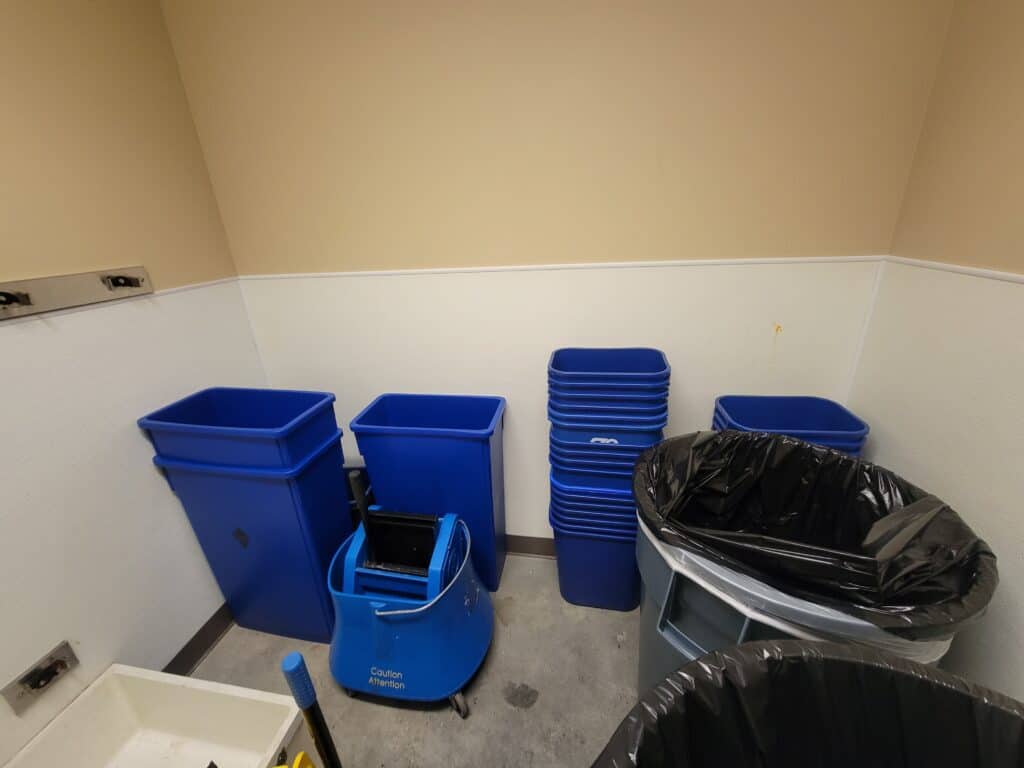
Above: Unused recycling bins stored in a trash room in North Hall. Photo courtesy of Evie Breitbach.
Students on campus may have noticed a key item missing from student housing this semester. The blue recycling bins have disappeared.
St. Ambrose University removed the blue bins from all student housing. The general consensus among students we interviewed is they are not happy about the removal and say it is not a good look for the university. While some students are not aware of the university’s stance on recycling and sustainability, others believe not enough is being done to promote sustainability at SAU.
“I don’t love the fact that the blue bins have been taken away,” says SAU Senior and RA Norah Perkins. “As someone who is an avid recycler, it makes me upset that I am unable to do that. I feel like recycling is something that is so easy to do, so I don’t understand why it’s being taken away.”
So why were the blue bins taken away? While Norah and many other students aren’t sure, others, like SAU junior Walter De Jongh, say they have an idea.
“The reason they took it away is because physical plant says people don’t know how to recycle, so they end up throwing it away anyway.” says De Jongh. “People recycle pizza boxes so those go in the dump. Ambrose’s solution was to take it (the blue bins) away.” Walter says he has his own ideas of what the university should have done instead. “I would have had the RAs have a meeting and tell people how to recycle, or have an incentive like maybe you get a free Stinger.” As it turns out, Walter’s explanation is spot on.
“There is currently no official statement,” says Director of Housekeeping, Derek Burkeybile when asked the university’s official statement on the removal of the blue recycling bins. “But the reason why (the blue bins were removed) is last year about 90% of recycling that was coming from the dorms was contaminated, meaning students were not using them in the correct manner, using them more as garbage cans.
“I brought this up to the sustainability committee to see what we could do about this, and the idea we came up with was for students to request recycling bins and watch a video on what kinds of things can properly be recycled. The RAs were then instructed to tell the students about this process during their first floor meetings, and students can currently request recycling bins if they wish to recycle.”
However, students and staff may still find a recycling bin here or there in the academic halls. “We still have recycling bins periodically placed on campus,” says Burkeybile when asked about the bins placed on the classroom level of McCarthy Hall. “The main push was to eliminate them from student rooms, unless they requested to have one.”

Above: An example of a recycling bin available on the classroom level of McCarthy Hall. Photo courtesy of Ross Willerth.
Regarding SAU’s other sustainability responsibilities, Walter and Norah had different thoughts on whether the university is doing enough to promote sustainability. Walter says, “I think SAU taking away from the recycling goes a lot against promoting sustainability. I don’t know if they do that much else, that I know of.”
Norah also raised her own concerns. “I think this is a tricky question because we have Sustainability Fest and Litterpalooza to promote sustainability, yet Ambrose doesn’t always do the simple things, like providing recycling bins to all residents.”
So what do the organizers of these events think about the removal of the blue bins, and what else is being done to promote sustainability at SAU? Paige Magistrelli, president of the Greenlife club and an SAU senior, added her perspective.
“I believe the removal of blue bins from student housing raises concerns about the university’s sustainability efforts. I understand that contamination in recycling is a serious issue, but instead of getting rid of the bins, finding ways to reduce contamination could be effective.” Paige suggests the following solutions: “Adding labels on or next to the bins could help students understand what to recycle. Providing separate bins for specific materials like plastics, paper, and aluminum could also help reduce contamination.
“Another option would be educational campaigns or workshops to encourage and teach students to recycle correctly. These ideas could help address the contamination issue while still supporting sustainability practices.”
On what the university is currently doing to promote a healthy environment, and how well they are doing, Paige adds, “St. Ambrose has made great progress with its sustainability efforts, but I believe there is always room for improvement. The university already uses energy-efficient lighting in some areas, promotes water conservation, and maintains a veggie garden. Roundtable talks, film series, and Sustainability Fest on Earth Day are all hosted to keep people connected to environmental issues.
“These are all great steps, but we can do more. Expanding green spaces, boosting energy efficiency, and offering more visible recycling options would make a big difference.”
As far as St. Ambrose’s future for sustainability, Paige says she is hopeful and is working hard to create an environmentally healthy campus. “I’ve teamed up with Hesham Goodman and the Sustainability Committee to work on projects like introducing vertical gardens and motion sensor lights in high-traffic areas to conserve energy,” says Paige. “We’re also looking into more solar panels and small wind turbines and bringing back the sustainability section on the university website. Plus, we’re working on launching an SAU Textbook Marketplace to help students reuse resources.
“I think St. Ambrose has the potential to improve, compared to other schools like UC Davis and Arizona State. If St. Ambrose could adopt similar strategies—like setting measurable goals and getting more people involved—we could take our sustainability efforts to the next level and build a stronger environmental plan for the future.”
If you are a student living on campus and would like to obtain a blue recycling bin, you may request one by filling out the physical plant request form, located on the SAU website.
Ross Willerth is a staff writer for The Buzz.