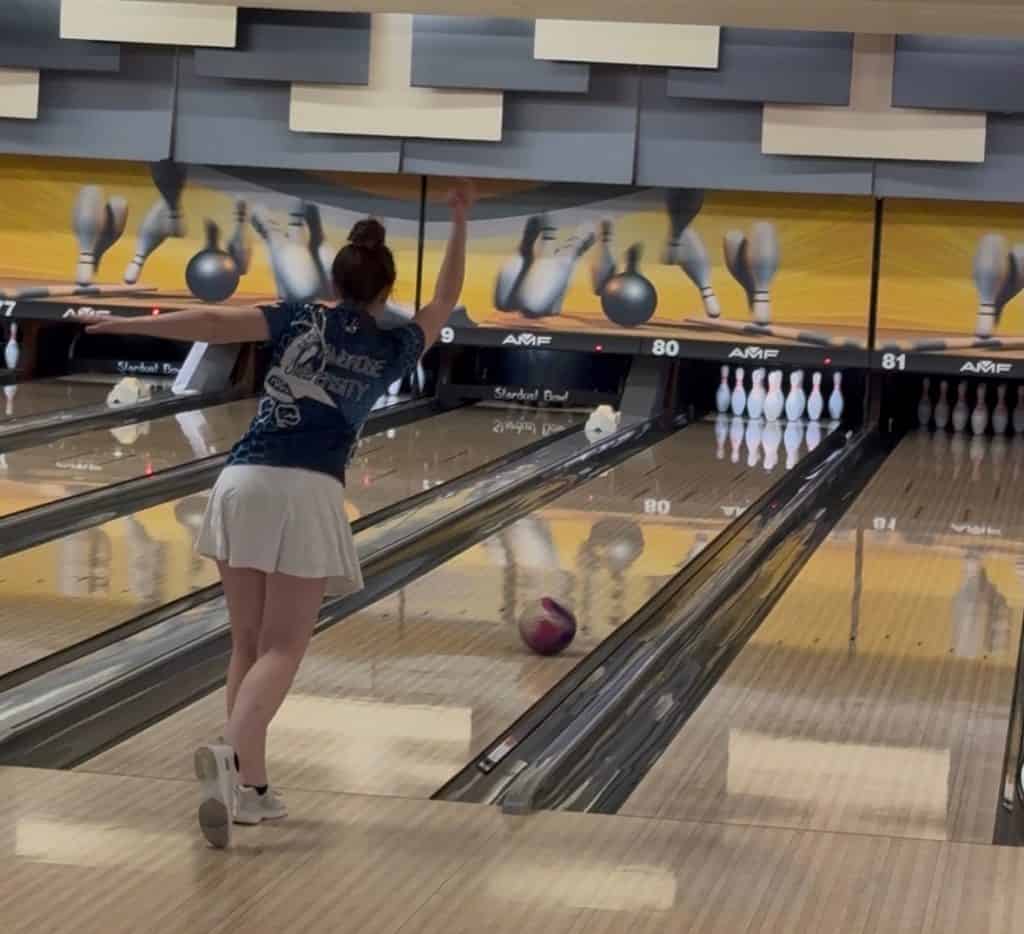
Photo Courtesy of Kathy Walsh
At just 24 years old, Delaney Walsh balances the demands of being a first-year student in an occupational therapy doctorate program while also dedicating her time as a volunteer JV Women’s Bowling Coach this past fall, shaping her identity both in and out of the classroom.
“I don’t want to be seen as the blind girl, you know, I just want to live my normal college life, be as young as possible, and do all that fun stuff.”
Walsh has always been a multi-sport athlete. Her sports ranged from T-ball and soccer to volleyball, tumbling, diving, and bowling. But everything changed after a car crash with her brother totaled her vehicle.
Though both emerged unharmed, people urged her to drive again. Within two months, however, she’d lost her central vision completely. The Doctor’s diagnosed her with Stargardt’s disease, a form of macular degeneration. It’s a rare inherited eye condition that affects the macula, leading to gradual central vision loss. It leaves a persistent gray blob in her sightline (like staring at the sun) and forces her to rely on peripheral vision.
“God put me in that situation with the car accident so I wouldn’t hurt myself anymore,” she says. “Like, He knew this was happening to me. How could He stop me from driving? Get rid of my car.”
“I always say that was a blessing in disguise.” This shift hit the summer before her junior year of high school, when she first noticed her vision was off.
For Walsh, becoming blind meant adjusting to a completely different way of living. She had to learn how to navigate school, social situations, and everyday tasks anew. All the while, she tried to keep up with the life she had built. Since her brother had the same eye condition, she had some understanding of what was happening. But that didn’t make the transition any easier.
“It was easy to explain to people,” she says. “I would just tell them, ‘Oh, I’m developing what my brother has,’ and then kind of throw it under the rug and move on.”
“I had to advocate for myself and put in that extra work,” she adds.
Behind closed doors, everything became extremely challenging. “My sophomore year, I was the starting setter on the varsity volleyball team. By junior year, I was barely playing on JV. By senior year, I was cut from the team because they didn’t want to accommodate me.”
She had to transition out of all athletics except bowling, which had been one of the biggest parts of her life up until then. “That was the only thing that gave me a purpose and a sense of self that I was losing.”
Bowling had been part of Walsh’s life long before her vision loss. She joined the high school team as a freshman because her brother had done it. She sought another activity to stay involved in. What started as just one more thing eventually became one of the few sports she could continue with confidence. It gave her a place to stay competitive and connected to the athlete she had always been.
“Luckily, you don’t really need your eyes too much in bowling,” she notes. She aims by trusting her physical form and keeping her body positioned accurately through her approach. She walks straight with a steady arm since she can’t see the lane arrows, pins, or board colors. Teammates call out remaining pins, and she adjusts based on results (like shifting left if pins stay on the right).
Everyone on her high school team was very accommodating. Outside of bowling, though, things got complicated.
“I didn’t know where my friends were in the lunchroom. I became more of an introvert and reserved. I wouldn’t know which way I was going. To the outside perspective, I looked fine. But I had to get pulled out of classes for blind training, learn to use different devices, and manage my academics and mental health. No one knew. I just did it secretly and transitioned that way.”
She still kept up with all her extracurriculars and held a job in the guidance office, returning passes to students and shredding papers. She involved herself in a lot of activities to bolster her college applications.
That effort followed her into college. Walsh first attended Augustana College, where she pushed herself academically while adjusting to life as a blind student. She joined a sorority, figured out accommodations on her own, and kept building confidence. She also continued bowling, staying connected to her athletic roots.
After graduating from Augustana with a bachelor’s in kinesiology, Walsh pursued a one-year master’s program in exercise physiology at St. Ambrose. Those studies bridged to something bigger. Conversations with faculty about her interests in kinesiology, psychology, art, and disability studies led her to occupational therapy. That now feels like the perfect fit. She’s especially drawn to low-vision rehabilitation, connecting her studies to her lived experience.
Her bowling career took a meaningful turn during her one year of eligibility last year at St. Ambrose. Walsh joined the team and earned a spot on Varsity and even competed in Las Vegas. That was a major moment in her college athletic experience. The trip stood out not just for the location, but for how far she had come. Bowling remained one of the few places where she could compete at a high level. It fueled her sense of purpose.
“I actually feel like I’m academically where I’m supposed to be,” Walsh reflects. For someone who spent years figuring things out alone, finding the right path was a major turning point. It gave her not just direction, but a way to turn her personal experience into a strength.
To cope with her demanding occupational therapy program, Walsh prioritizes time management, rest breaks, and “me time” to avoid burnout. She leans on her cohort for resources, dives deep into unfamiliar concepts, and chats frequently with professors. Readings remain a challenge.
Landon Mathiason, Walsh’s boyfriend, sees her strength in how she handles school and life. She balances them by blending the two, drawing in friends and family when she can. Under pressure, she faces it head-on rather than avoiding it. “She’ll reserve study rooms and dedicate hours of focused time to fully understand her material,” he says. When setbacks hit, she reflects: “What went wrong? What can I do about it now? What can I learn? How can this make me better moving forward?”
Landon recalls one standout memory: a trip to TJ Maxx, where Walsh helped an older woman evaluate a backpack. She broke down features like comfort, accessibility, and back-pain prevention, going “above and beyond.” To him, it showed her true character: “insightful, compassionate, attentive, knowledgeable, patient, and genuinely caring.”
Walsh has grown immensely since starting college. What began as a difficult adjustment has become a story of confidence, persistence, and purpose. She’s learned to live with blindness without letting it define her. She’s building toward a future in occupational therapy. For Walsh, the goal has never been just to endure change. It’s to keep moving forward.