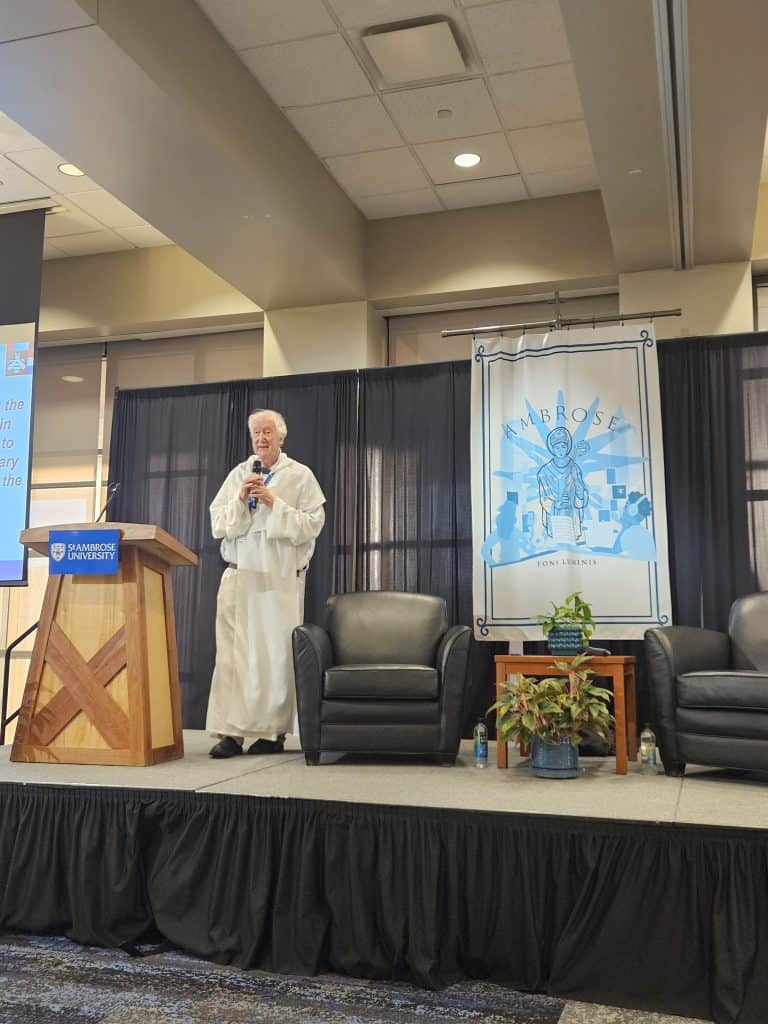
Cardinal Timothy Radcliffe of London delivers his keynote speech at SAU in a conference addressing how the Catholic Church can offer hope to Gen Z. Photo Courtesy of George Coin
By: George Coin, Buzz staff writer
If you think young people are simply walking away from religion, a recent conference at SAU suggests it’s not so simple. They’re still here, still asking questions, and still waiting to be heard.
The conference, FROM A(MBROSE) TO (GEN.) Z: Resourcing the Tradition in Response to Contemporary Concerns in the Church took place over the weekend of April 24th and brought together students, faculty, clergy, and national Catholic leaders to examine how the Catholic Church can engage with and offer hope to Gen Z.
From the opening session, organizers make it clear the event is meant to be a conversation, not a lecture series.
The keynote speaker, Cardinal Timothy Radcliffe of London, centered his message on a simple but challenging idea: hope begins with listening. Rather than prescribing solutions from a distance, he emphasized that the Church must engage young people directly, learning from their questions and experiences. The goal, he suggests, is not to “fix” Gen Z but to walk alongside them in a world that often feels unstable and overwhelming.
“Hope is something we receive from the young as much as we give it to them,” he said, emphasizing that the relationship between generations must go both ways.
Still, the path forward is not simple. The Church faces a balancing act between tradition and adaptation.
In another session, Dr. Nabil Tueme of the Springtide Research Institute presented findings that show while only about 16% to 22% of young people identify as Catholic, that number has remained relatively steady. Though at the same time, she says that many remain loosely connected.
“Between 20 and 30 percent of young Catholics express ambivalence,” Tueme explains, meaning they stay affiliated while questioning the Church’s relevance or teachings.
She says that sense of distance often comes down to connection, or the lack thereof. The concern is especially relevant for Gen Z, a generation that grew up alongside the internet and social media.
While online platforms purportedly offer connection, they often deliver what another speaker, Dr. Timothy Matovina, calls the “illusion of connection,” leaving young people searching for something more tangible.
That reality shapes what young people expect from the Church. In a session on mental health, Dr. Mara Adams stressed that emotional struggles must be taken seriously. “Emotional suffering is a legitimate spiritual condition, not a moral failure,” she says, calling for a Church that responds with compassion rather than judgment. Adams says that if the Church wants to reach Gen Z, it must engage the issues like mental health that actually define their lives.
For Gen Z, Adams says that hope is not abstract. It is something practical and tangible that helps them navigate anxiety, pressure, fear, and uncertainty.
The conference also addressed topics like sexuality and identity. Dr. Julia Sadusky noted that “between 20 and 28 percent of Gen Z adults identify as LGBTQ,” making these conversations unavoidable for any meaningful outreach. But how the Church approaches them matters just as much as whether it does.
“If we’re silent, people feel like the Church has nothing of value to say,” she explains. “If we shout, it’s hard for them to listen.” The path forward, she suggests, is neither silence nor confrontation, but thoughtful, compassionate engagement.
The Buzz reached out to student attendees to gauge their opinions of the conference. SAU senior computer science major Charli McGill emphasized the importance of authenticity. She says Gen Z is not interested in a “marketed” version of the Church, and that attempts to appear trendy or “relatable” often fall flat.
McGill notes that efforts to seem “hip and cool” can actually have “a reverse effect,” feeling forced rather than genuine. Instead, she says what resonates are spaces where people feel heard, valued, and part of a real community.
Senior cybersecurity major Michael Hughes framed the issue in terms of perspective. Gen Z, he says, has access to more information than any previous generation, allowing them to see the world “in such high resolution.” But that clarity comes with a cost: “It can be so informed that it’s almost overwhelming.”
For Hughes, engagement starts with conversation. Too often, he says, the Church can feel distant or intimidating—“this enormous monolithic thing.” What changes that perception is not messaging, but interaction. “If you can start a tradition that includes and embraces conversations like this,” he explains, “you can get some really interesting perspectives that you might not otherwise have.”
Conference speaker Juan Miguel Alvarez highlights this point. “Ministry is not limited to religious education and parishes. It’s actually young people who are recognizing the need to expand the horizons of ministry. They’re the ones leading that conversation.”
That emphasis on dialogue ran throughout the conference. McGill points out that “there’s a lot of discussion on the top end…and not a lot of discussion with students and how it actually impacts student life.” If the Church wants to reach Gen Z, she argues, it cannot rely on top-down communication. It must create space for young people to speak, be listened to, and be taken seriously when they do.
At the same time, the conference pushed back against the idea that relevance requires abandoning tradition. In fact, Springtide’s research suggests the opposite: many young people are drawn to the Church because it feels “timeless” and “real” in contrast to the curated, filtered world of social media, reality TV, celebrity culture, and the broader media landscape. In a digital world where connection often feels shallow, authenticity and stability become powerful.
“They describe their faith as something that’s lived, that’s felt, that’s relational,” Dr. Tueme explains, pointing to community and personal connection as key reasons young people remain Catholic.
For Cardinal Radcliffe, that is where hope ultimately takes shape. Not in sweeping changes, but in small, consistent acts of engagement. The Church, he suggests, must be present in the uncertainty young people face, offering “not easy answers but companionship, meaning, and a willingness to listen.”
Conference participants learned that Gen Z does not disengage because they have no interest in faith. They disengage when they feel unheard.
And when the Church listens—really listens—it may find that hope is not something it has to create from scratch. It is already there, waiting to be realized.