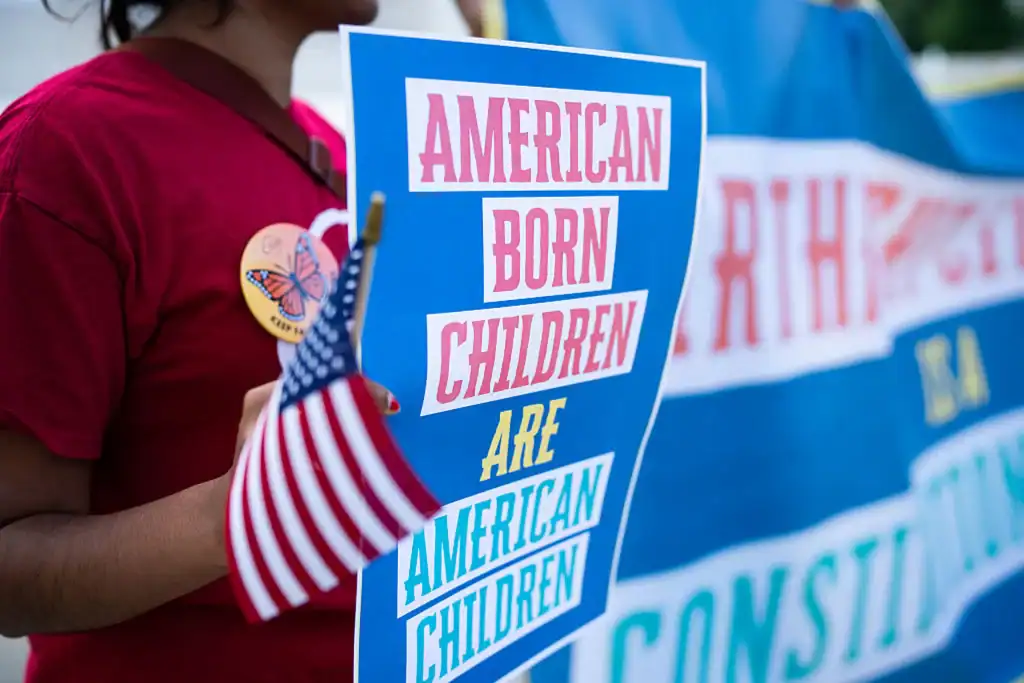
Many American citizens are concerned about where their citizenship stands as national conversation about birthright citizenship has intensified. Beginning early in 2025, the Trump administration issued an executive order to reinterpret the 14th Amendment and take away birthright citizenship away from children born to parents without lawful status in the U.S.
The Supreme Court is currently in the middle of legal battle to determine the constitutionality of this order, as of this moment the implementation if this order is blocked by federal injunctions and multiple class action lawsuits.
“I think the lives of children born in the U.S. to immigrant parents would change a lot if birthright citizenship was taken away,” says senior Political Science major, Dora De la Cruz, “Many could grow up feeling like they don’t fully belong in the only country they’ve ever known.”
Redefining American Identity
Since 1868, following the addition of the 14th Amendment in the U.S. Constitution, birthright citizenship has been a guarantee to all children born in the U.S. regardless of their parent’s immigration status, with very few exceptions.
Senior human performance and fitness major, Connor Ludtke, says he believes without birthright citizenship the identity of the U.S. would be permanently changed.
“The idea of the American dream is what brings a lot of people to this country, to give their children and future generations a chance for a better life and higher potential,.
“Without birthright citizenship, that opportunity is stripped from hundreds of thousands of families, the promise of a better future that America brings would be gone.”
This policy would likely result in thousands of children being born annually without legal status which in result would limit their access to multiple necessities including healthcare, education, future employment, and many more.
“It would create a lot of uncertainty about their legal status, access to education, healthcare, and even basic rights,” Cruz explains. “Many immigrant families are already scared about what their future in the U.S.”
Interpreting the 14th Amendment
Part of the argument the Trump administration is making is that the 14th amendment was interpreted too broadly. They claim that the amendment was not originally intended to apply to all children of non-citizens.
“I understand the concern for immigration in the U.S. to a point but I don’t believe that birthright citizenship is part of the issue or what we should be focusing on,” says Junior education major Lucy Byrkit.
“These children were born in the U.S. and for most of them the U.S. is all they know, that in itself should make them U.S. citizens. If anything, taking away birthright citizenship would make the number of undocumented people in the U.S. increase which is the exact opposite of what Trump wants.”
Increasing Fear and Prejudice
The issue of discrimination and profiling has been a hot topic in the U.S. currently with Immigration and Customs Enforcement (ICE) entering many U.S. cities and arresting, deporting, and even killing individuals who ICE agents believe aren’t U.S. citizens simply based on their appearance, whether or not they are correct. Many people believe that this order would make this problem much worse.
“Taking away birthright citizenship would open the door for ICE and other anti-immigrant agents to assume someone isn’t an American citizen simply based on their appearance,” says Byrkit.
“It also limits an individual’s ability to prove their citizenship as a U.S. birth certificate would no longer be considered proof of citizenship for children of immigrants. The country would be up in arms even more than it is now.”
Awaiting Supreme Court Decision
The Legal Defense Fund (LDF), a nonprofit organization focused on defending and fighting for racial and social justice, says the Supreme Court is skeptical of the President’s ability to reinterpret the constitution simply through an executive order. “Although Congress may try to change federal laws protecting birthright citizenship, birthright citizenship is also enshrined in the Fourteenth Amendment.”
Many officials for LDF believe that making a decision that would change constitutional law that has been in effect for years should have to be a constitutional amendment rather than just an executive order. “Any attempt to take it away would require changing or amending the U.S. Constitution.”
As the Supreme Court prepares to issue its ruling on this matter the future for children of immigrants remains uncertain. This decision could completely change years of understanding concerning citizenship in the United States.
For now, the executive order remains blocked and birthright citizenship will continue, but the fear of the future remains in the up in the air as the world watches closely to see the Supreme Court’s ruling excepted in late June or July of this year.