Photo Courtesy of Axios.
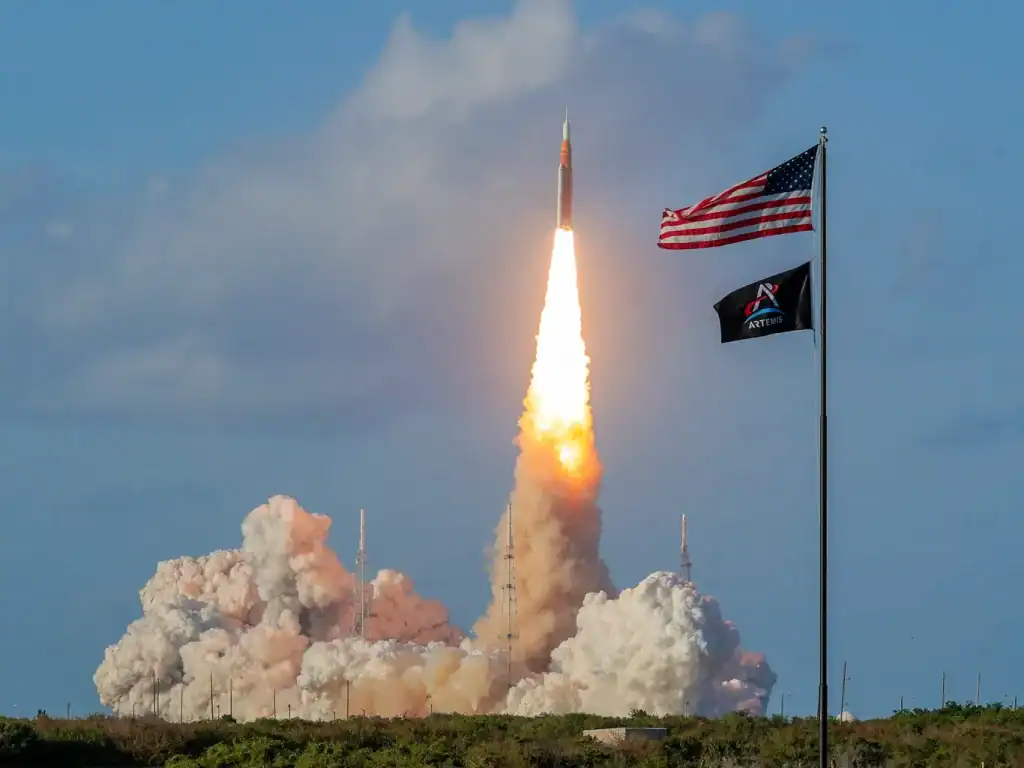
The historic space mission, Artemis II, caught the attention and imaginations of SAU students. The rocket launched on April 1st, 2026, from Launch Complex 39B at NASA’s Kennedy Space Center in Florida. The mission consisted of a 10-day trip orbiting the moon, making it the first human return to space since the 1970s.
“It is going to be hard to tell how this is going to play out with all the attention it is going to get, some might even say it is hard to believe,” says sophomore elementary education major Tristen Smith.
Astronauts Reid Wiseman, Victor Glover, Christina Koch, and Jeremy Hansen made history at becoming the first humans to travel the furthest from Earth, at 252,756 miles in space.
NASA’s Mission
According to NASA, the Artemis II mission carried astronauts farther from Earth and closer to the Moon than any human has been in over half a century. Artemis II crew would then work with scientists on Earth to facilitate science investigations to inform future human spaceflight missions. On the journey to the moon, Spacecraft Orion flew by the far side of the Moon to the side that always faces away from Earth. The purpose of Artemis II is to prepare for Artemis III, which aims to land astronauts on the moon.
Sophomore nursing major Ellie Rude says, “I think it is super cool to be alive to witness history. I think it’ll be interesting to see if people think that this mission to space is fake or real since people today still say we never actually went to the moon”.
Artemis II was a very popular topic of discussion on campus during the week of the launch.
Artemis stayed on this side of the moon for three hours, where the astronauts studied and analyzed geological features, such as impact craters and ancient lava flows. The Artemis II mission made its return to Earth on Friday, April 10, in the Pacific Ocean, near San Diego.
Artemis II went beyond the protective layer, the magnetosphere, and the spacecraft was exposed to some of the harshest elements in space. Both NASA and the NOAA collected data from solar flares, coronal mass ejections, and solar winds, all which are very powerful phenomena that could one day possibly disrupt human electronic systems on Earth.
SAU’s thoughts: Will we go to Mars?
According to SpaceX, in late 2026 they plan to launch the first unscrewed Starships to gather data on entries and landings. They hope to be able to take a mission to Mars in 2031. Mars has freezing temperatures, excessive solar radiation, fine dust that can damage solar panels and spacesuits, and a surface rife with toxic, corrosive salt.
NASA has a Perseverance rover that is on Mars, that is currently looking for signs of microbial life, and it also tests spacesuit materials to protect life and prepare the future astronauts on what to expect when they make their journey there.
SAU students here on campus have their own thoughts and opinions on whether they will live to see people on Mars.
Sophomore nursing major Maya Oliver thinks she will live to see that day. “I think that with all the new technology, it will happen very soon, which is kind of scary,” she says.
Austin Hicks, a sophomore and Exercise Science major, also says he thinks we will go to Mars. “I think we will definitely send someone to Mars sometime soon, but as for actually living on Mars I don’t think that will be a possibility at least in my lifetime.”
Looking Beyond the Moon
A heartfelt moment in the spacecraft, astronauts Reid Wiseman proposed to name a moon crater after his late wife, Carroll who died of cancer in 2020.
According to NBC News, Carroll Wiseman “dedicated her life to helping others as a newborn intensive care unit registered nurse,” NASA wrote.
Wiseman described the crater as a “bright spot on the moon”. Crew member Jeremy Hansen said, “We lost a loved one; her name was Carroll, the spouse of Reid, the mother of Katey and Ellie. We would like to call it Carroll.”
Senior nursing major Annie Rude says, “When I first saw that I thought it was the cutest and sweetest thing he could have done to honor his wife”.
In the end, this mission represents more than just sending people to orbit the moon. It represents the next steps in human exploration. The astronauts not only made a huge step in preparing for the next mission to the moon, but they also went beyond human achievements.