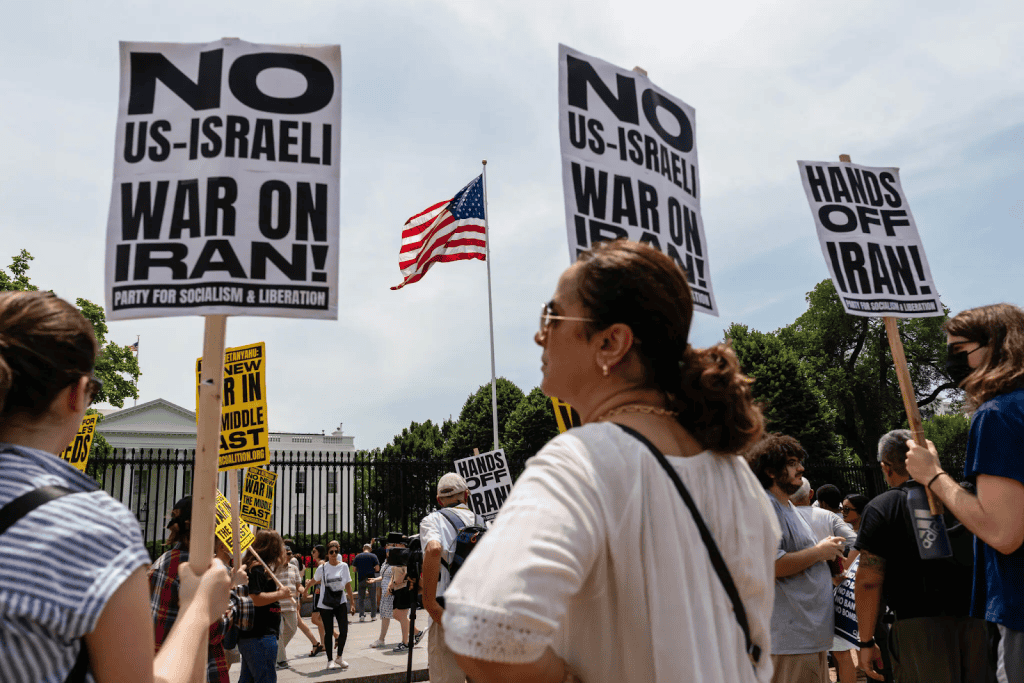
Demonstrators hold signs against the U.S. strikes against Iran in Washington outside the White House on Sunday.
Photo courtesy of Eric Lee for The New York Times
On April 7th 2026, President Donald Trump and the government of Iran agreed to a two-week ceasefire deal. The deal follows comments President Trump made early in the morning on the Social Media site Truth Social, where he said “A whole civilization will die tonight, never to be brought back again.” The comments brought several cries of Impeachment from those on both sides of the aisle.
“The Buzz” spoke to several SAU students, who shared their unfavorable opinions on the ongoing war in Iran. One such student was freshman Biology major Claire Lemaster, who said, “Trump started an unnecessary war with Iran, and now he is threatening to wipe out an entire country. A country full of innocent people. He is entirely out of line and, frankly, a horrible person.
“Then he has the audacity to post about it to his little social media platform, which is incredibly juvenile and unprofessional. He campaigned on the idea that he would end wars and lower gas prices. Evidently, he’s a liar, and I’m not sure how people support him. If there wasn’t enough evidence that he was a bad person before, calling for a genocide should certainly be enough.”
Senior Exercise Science major Vincent Meo also spoke of Trump’s campaign promises, saying, “The Iran war is a disaster, no matter what part of the political spectrum you fall on, and it really calls into question the thoughts that MAGA supporters have, considering that less than one year ago, they supported the pro-peace president.
“Now they are supporting, almost unanimously, a president who is the complete opposite, in fact, one who has outwardly celebrated the killing of Iranian people, even getting excited over the complete decimation of a sovereign nation and its people.”
The war in Iran began on February 28th, 2026, when the United States and Israel jointly attacked Iran during “Operation Epic Fury”. During the operation, the Supreme Leader of Iran, Ayatollah Ali Khamenei, and other senior officials were killed.
One major aspect of the ceasefire deal was that Iran was going to grant safe passage to ships through the Strait of Hormuz. The Strait, which had been closed since the initial attack, is one of the world’s busiest oil shipping channels.
According to the BBC, around 20% of the world’s oil and liquefied natural gas usually passes through the strait. However, the promise to reopen the Strait was quickly reversed, as Iran said it would keep it closed as long as Israel continued bombing Lebanon.
Starting on April 13th, the United States created a blockade of its naval vessels in the Gulf of Oman beyond the Strait of Hormuz. Several ships with ties to Iran have been stopped or turned around since the blockade again. Admiral Brad Cooper, head of U.S. Central Command, said that “U.S. forces have completely halted economic trade going in and out of Iran by sea.”
It is unclear how strong the ceasefire is, and how long it will last, as U.S. Vice President JD Vance called it “fragile.”
A majority of the students “The Buzz“ spoke to called out Trump for not following through on the promises he made during his campaign. Senior Psychology major Celia Cervantes says, “I believe that this war was started out of hatred and greed by the administration that we are currently under. Additionally, for a president who campaigned on ‘no wars’ and ‘lower fuel prices, ’ falling back on those promises is not surprising given his past actions, but is nonetheless still extremely disheartening and disappointing.”
Other students touched on the President’s justification for the war, such as junior Alexis Hill. “I think that he is using the same rhetoric he spoke out against years ago to attempt to justify this war, which is mostly for his own financial gain.”
President Trump and other members of his administration claimed that Iran was weeks away from having nuclear power, and that the United States needed to attack Iran before Iran could attack the United States or our allies. This statement has been refuted by many nuclear experts, such as Jeffery Lewis, an expert on nuclear weaponry for the James Martin Center for Nonproliferation Studies at the Middlebury Institute of International Studies, who recently commented that “There was no evidence that Iran was close to a nuclear weapon.”
At this point, experts and American citizens alike are unsure where the conflict will go from here, as there are many different variables at play. Many SAU Students expressed their support for the end of the war, expressing that it is an unnecessary conflict that harms the American people.
“I, like many other Americans, want this war to end not only for the safety of American troops, the affordability of gas and thus all other goods and services, but also to protect the sovereign nation that is Iran, which posed no immediate threat to the United States,” said Vincent Meo.