Photo Courtesy of: Casper Altman
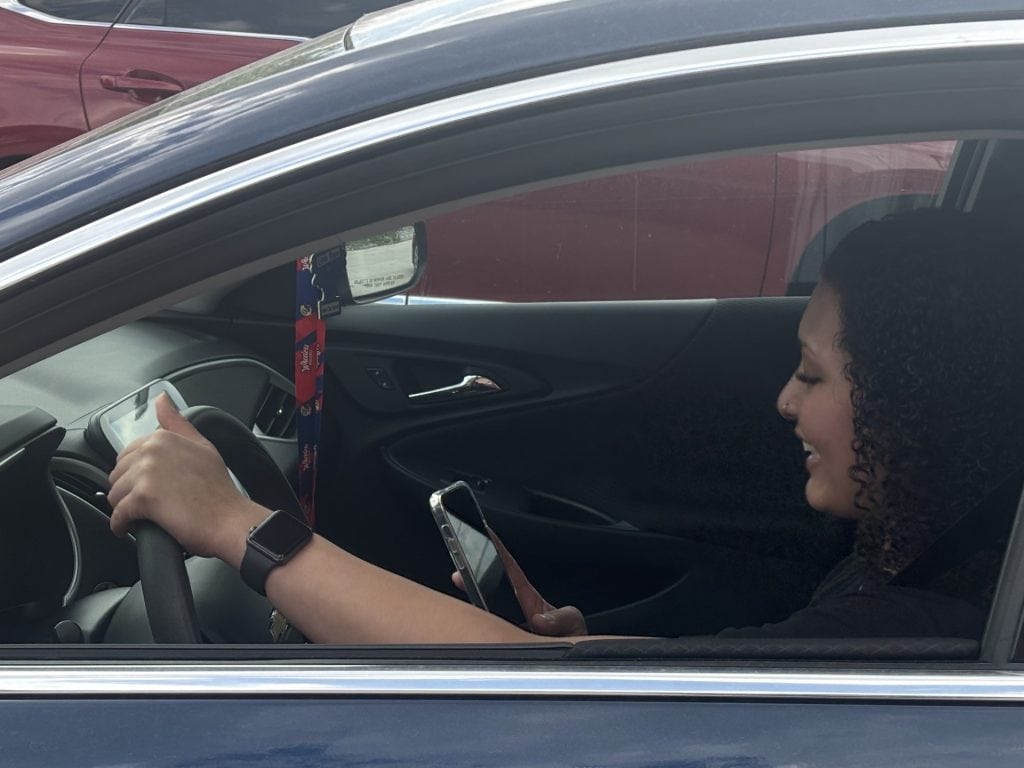
Ambrosians from all over the Quad City area commute to campus every day. With so many students and faculty traveling, distractions while on the road become real. A new Iowa law is now penalizing distracted drivers.
Unfortunately for Jessica Vargas, SAU senior, she has experienced the consequences of distracted driving firsthand.
“I have gotten into a car accident due to texting and driving. It definitely taught me to pay close attention to the road,” Vargas says.
Since January of 2026, Davenport has already reported 89 crashes linked to distracted driving or inattentive driving, according to the Davenport Police Department. Of those 89 crashes there was one fatality, one serious injury, and several minor injuries. Showing that even a brief lapse in attention can be dangerous and costly.
During this same time, Davenport officers have issued 45 citations for hand-free driving violations. While that number may seem small compared to the number of crashes, police say it only represents a fraction of the problem.
Lt. Nick Shorten, traffic safety unit commander with the Davenport Police Department says, “It’s a problem everywhere… just driving around, you see it. If you’re not paying attention to what’s going on around you, there’s the potential for serious accidents.”
Those local numbers come as Iowa’s new hands-free driving moves into full enforcement. After a warning period from July to December 2025, drivers can now be fined starting January 1, 2026, for using handheld devices behind the wheel.
According to WQAD, law enforcement agencies across the state spent months educating drivers before issuing citations. Now, officers are shifting toward stricter enforcement in hopes of changing driver behavior.
Lt. Shorten says the law specifically targets handheld devices use, including activities like scrolling, watching videos, texting, or entering GPS directions while driving. Lt. Shorten says that distracted driving goes beyond just hand-held devices.
“People are doing other things like eating or applying makeup,” Lt. Shorten says. “Those are distractions too, even if they’re not specifically part of the hands-free law.”
While enforcement has increased, Shorten says there are limits to how much offers can do.
“Officers see it all the time, but they’re not always able to stop every driver. They might be on their way to another call.”
To combat this, Davenport Police and other agencies work in collaboration to enforce safe driving habits. This includes dedicated patrols focused on distracted driving. These patrols specifically watch for drivers using their phones.
In some operations they use spotters to identify violations and alert nearby patrol units who take over from there. Shorten says, “we’re trying to change behaviors, it’s not just about writing tickets.”
According to KWQC Under Iowa’s hands-free law, drivers face fines starting at $100. Shorten shares that most of those first-time tickets come in at round $170.
KWQC also shares that a distracted driving incident that causes injury is $500. If the incident causes death tickets could start at $1,000. Additional fees may increase the overall cost of each incident.
Callie Thomas, SAU senior, says, “I think $100 would be enough to stop people but some people work differently. Money may not motivate everyone.”
Changing Habits
Thomas says she avoids using her phone while driving by using voice controls instead.
“If I need to message someone or change music, I use Siri, so I can stay focused on the road,” Thomas says.
Shorten emphasizes that all drivers should utilize hands-free equipment like Bluetooth. That even a few seconds of distraction can have serious consequences.
Officer Shorten says “at 55 miles per hour, taking your eyes off the road for about four seconds, the time it takes to read a text, means traveling roughly the length of a football field without looking.
“A lot can change in that time. A car could suddenly stop, or someone could step into the street. You just can’t predict those things.”
That unpredictability is what makes distracted driving so dangerous. Many drivers assume nothing will happen during a quick glance at their phone, but those few seconds can be enough to cause a crash.
For many students, the biggest challenge is not awareness, but rather habit and convenience.
Vargas admits that she initially changed her behavior when tickets started being issues but has since noticed herself slipping back into old habits. “It’s just the feeling of having to respond immediately, especially when it is work.”
She says boredom during long and repetitive drives can also lead to distractions. “My phone becomes my distraction. Music doesn’t always keep me engaged.”
Even with the law now in effect, not all drivers fully understand the details.
Vargas says she was aware the law was coming but did not have much information about it and that she believes enforcement could be stronger.“They’re really trying, but I don’t think they’re enforcing it as much as speeding laws.”
Shorten acknowledges enforcement has limits and shares that education and consistency will play a key role as efforts move forward.
“No one plans to get into an accident, but it only takes a few seconds for something to go wrong.”
Shorten shares that Davenport’s younger drivers, particularly those aged 16-24, are among the most frequent offenders. However, the 25-44 age group is a close second in infractions. “We’re all connected to our device more than we need to be.”
To learn more about traffic safety concerns located on Gaines Street near the St. Ambrose campus click here.