Photo Courtesy of Jonna Tucker.
What started as a simple cheek swab at a campus table in the Beehive turned into an opportunity for SAU senior Jonna Tucker to help save a life. Two years after joining the national donor registry for bone marrow and blood stem cells, Tucker was called to donate blood stem cells to a patient battling a serious blood disorder.
Someone Tucker has never met and may never meet, but whose life could be changed by her donation. Tucker says, “I think it’s just a really cool opportunity to be able to have that big of an impact on someone’s life”.
Tucker donated her blood stem cells through the National Marrow Donor Program (NMDP).
The Impact of NMDP
NMDP is a global nonprofit organization that connects patients with blood cancers and other serious blood disorders to donors. Since its founding in 1987, NMDP has helped facilitate transplants for patients who cannot find a matching donor within their own family.
According to the organization, about 75% of patients needing a transplant do not have a fully matched donor in their family.
Tucker says her decision to join the registry was influenced by someone she knew growing up who battled blood cancer and benefited from a transplant. “It was probably the thing that I would say helped them the most in their treatment”.
When Tucker encountered the donor registry drive on campus, the choice felt clear. “I thought, like, if I could help someone else that much, then… I mean, I would… that’s what I want to do”.
Like many students who consider joining the registry, Tucker admitted she initially felt nervous. “I definitely was a little nervous, because I just didn’t know exactly what the process would be”.
Inside the Donation Process
Joining the registry itself was simple. After completing a cheek swab at the campus table, Tucker went on with her day unsure if she would ever receive the call to donate. Nearly two years later, she got that call from a program coordinator telling her that she had a match.
The program coordinator began arranging doctors’ appointments and scheduled travel to New York for the donation. However, after a major snowstorm hit the East Coast, last-minute changes had to be made.
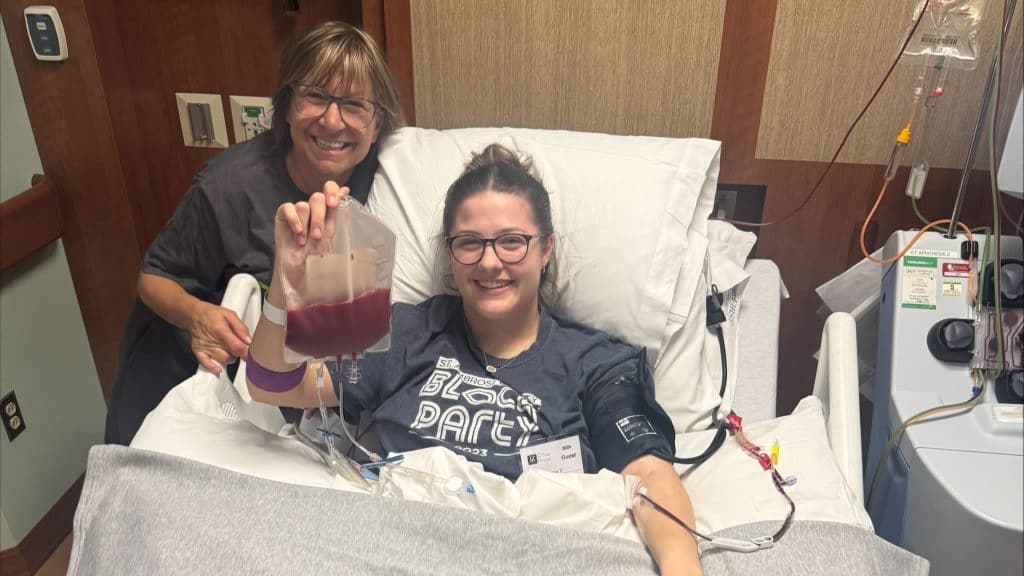
Within 24 hours, program coordinators arranged a new donation location near Chicago. The changes also meant a new travel companion. Coordinators booked a last-minute flight for Tucker’s mother, who flew from Utah to Chicago to accompany her.
During the donation, Tucker underwent a process where blood was drawn from one arm, passed through a machine that separated the stem cells, and then returned to her body through the other arm. Tucker says, “I felt really tired and I had a headache, but honestly, I just took a really long nap, and I was fine”.
Though the process left her feeling tired afterward, Tucker said the experience was meaningful, especially after meeting patients receiving treatment at the cancer center. The moment the donation truly became real came the next day when she received confirmation that the male patient had received her stem cells and was doing well.
Tucker says, “Everyone was telling me, like, ‘oh, you’re helping save lives,’ and it’s like… I don’t know, that’s a weird thing to wrap your head around, really, that you can have that much of an impact on someone that you don’t even know”.
Looking back, Tucker said the experience left a lasting impact. “It definitely left me feeling very good and it made me feel happy, honestly, that I could do that for someone,” Tucker said.
Now she hopes other students will consider joining the donor registry if they have the opportunity. “It’s such a rewarding feeling knowing that you made such an impact in someone’s life,” Tucker said. “I think if you have an opportunity to do it and you can do it, I definitely think you should.
“It was a really cool experience, and I’m honestly just really glad I got to do it.
How Can You Register?
People interested in joining the donor registry can do so by visiting the NMDP website and requesting a free swab kit. The process begins by answering a few eligibility questions and receiving a kit in the mail, where participants simply swab the inside of their cheeks and return the sample using a prepaid envelope.
Eligible donors must be between the ages of 18 and 35 and meet basic health guidelines. Once registered, donors remain in the registry and may be contacted if they are identified as a potential match for a patient in need of a life-saving blood stem cell or bone marrow.