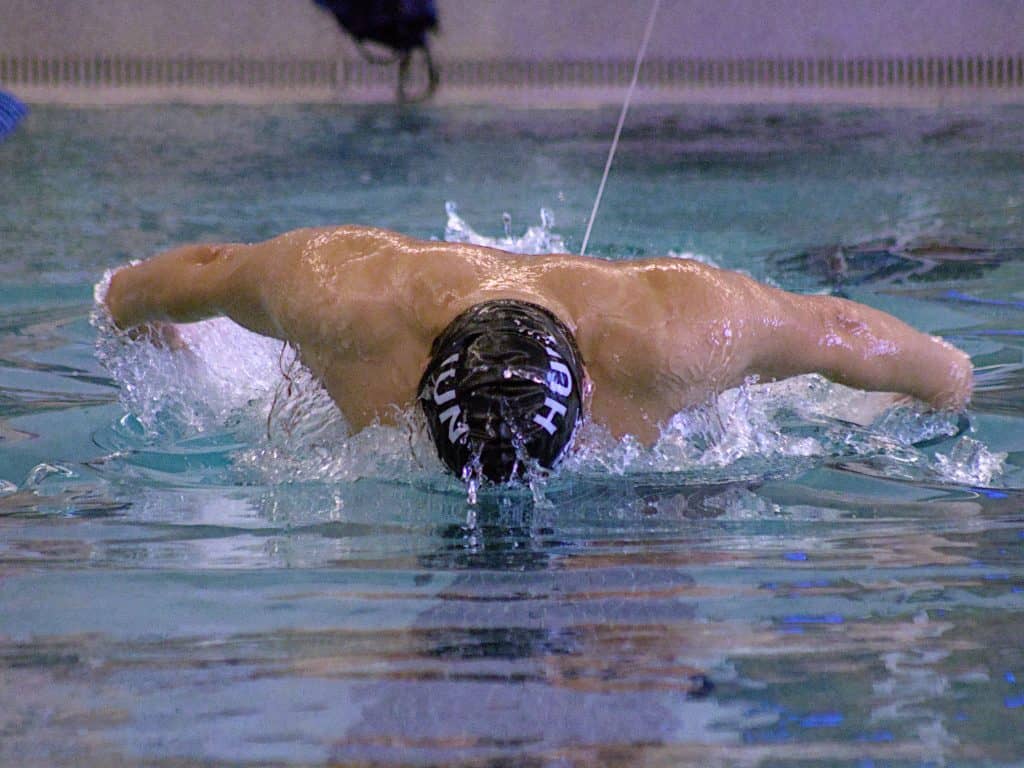
“SAU freshman multimedia journalism major György Domonkos powers through the butterfly during a meet this season.” Photo by Luke Sproule.
By: George Coin, BuzzStaff Writer
On most mornings, freshman multimedia journalism major György Domonkos wakes around 8 a.m., heads downstairs for breakfast with his teammates, and quietly checks the day against a schedule he has already mapped out in his head. Class. A call home. The gym. Study time in the library or the Beehive. The rhythm is steady and methodical. He says it is the product of more than a decade spent in the water. He prefers to stay on schedule. In a sport decided by fractions of a second, control matters.
György hails from Hungary but says he chose to come to SAU because “the campus was nice and the coaches were nice enough to talk with me for a long time, the swim team is good, and the communication department here is the best.” He does not separate swimming from storytelling. He lives in both worlds at once. A lifelong swimmer and aspiring sports journalist, he describes his path with the clarity of someone who decided early. “I’ve always loved sports,” he says. “I just like to talk about them, play them, write about them, or even commentate them.”
He says he always knew life would be about sports.
Swimming shaped much of his childhood. He says that the sport instills discipline, scheduling, and respect for authority. It builds habits that now structure his college life. In Hungary, Domonkos trained and competed through club teams rather than school programs. “You don’t play for your high school or your college. You are doing club all your life,” he explains. There are no college sports in Hungary.
György says it is primarily this lack of college athletic opportunities back home that inspired him to study abroad. He also says that a degree from a university in the United States carries more international recognition than the same degree from a Hungarian university and this also influenced his decision. “I worked a lot at home on my sports, and basically, you don’t get anything out of it if you’re not like an Olympian. You can’t go to university with it. This is an opportunity to come here and enjoy what I worked for.”
He says what surprises him most about coming to SAU is not the campus or the classes, but the people. The unfamiliar friendliness stood out to him immediately. Back home, interactions tend to be more direct and less outwardly warm. “It’s just different – like, you don’t go up to someone who doesn’t know you and start talking about ‘How are you?’ You don’t know him, why do you care how he is?” he says with a laugh. The stereotypical Midwestern politeness catches him off guard, but in a good way.
Strangers hold doors. Classmates introduce themselves. His teammates were quick to welcome him and provided him with an instant friend group. He describes Americans as “friendly” and “open-minded,” which makes the transition easier than originally anticipated.
There is one exception.
Midwesterners, he says with a grin, are terrible drivers.
During the swimming season, his days revolve around practice and coursework. It is a pattern he has followed for nearly 10 years. The hardest part now is not the training; it is the academic deadlines. Multi-day swim meets leave little energy for homework. “You can’t really work during the meet because you are tired or at the pool deck all day.”
Catching up becomes its own event.
Still, the reward outweighs the strain. “Being with your team and cheering for them or them cheering for you,” he says, makes all the effort worth it to him.
“When you’re far from home, your friends become like family,” he says. Before long, that is exactly what his teammates became. Living and training in such close circles has a way of turning friendships into something deeper, and he says one teammate’s townhouse now feels like a second home. The distance from Hungary is still there, but the daily calls and video chats help bridge it. He says what he misses most is not so much the people as it is “the place itself.”
Coming to the United States provides more than just a change of scenery. It feels, he says, like “the start of my adulthood” – a chance to begin with “a clean page.”
The metaphor fits both swimmer and writer. In the pool, every race resets at the starting block. In journalism, every story begins blank.
His events, the individual medley and butterfly, demand precision and endurance. He says he approaches swim meets with the same structure he applies to class. About 90 minutes before stepping into the pool, he listens to music and maps out exactly what he will do and when he will do it.
Domonkos says his interest in sports journalism developed in parallel with swimming. Around ninth or tenth grade, Domonkos says he realized that he wanted to pursue a career in sports. “This is the only thing I know.” Writing and media offer a way to remain close to competition without the physical exhaustion of coaching or training forever.
Being an athlete subtly changes how he views reporting. He understands team dynamics and how prospects develop. “I know how things work.”
He also recognizes the friction that can arise between athletes and journalists due to miscommunication or misunderstandings. This is something he hopes his personal experience as an athlete will help avoid. Sometimes, he admits, reporters ask questions that feel obvious to those inside the sport.
Academically, however, the biggest adjustment has been linguistically. He speaks English comfortably but says that the academic English found in some textbooks requires more focus and effort to comprehend. Philosophy proves most challenging, while media writing and media and society classes stand out as favorites.
He enjoys crafting stories more than writing traditional composition essays and says that over time, the strain of reading complex texts has eased.
When asked what success looks like, Domonkos does not mention trophies or money. “Being happy with what I’m doing.”
In five years, he hopes to be back home in Hungary, working in journalism or television production.
His life now moves between chlorine and copy, between practice sets and story drafts. He calls his parents daily. He studies in the library. He reads crime novels. He plans. He schedules. He improves.
He says that swimming has given him endurance. Journalism, he hopes, will give him voice.