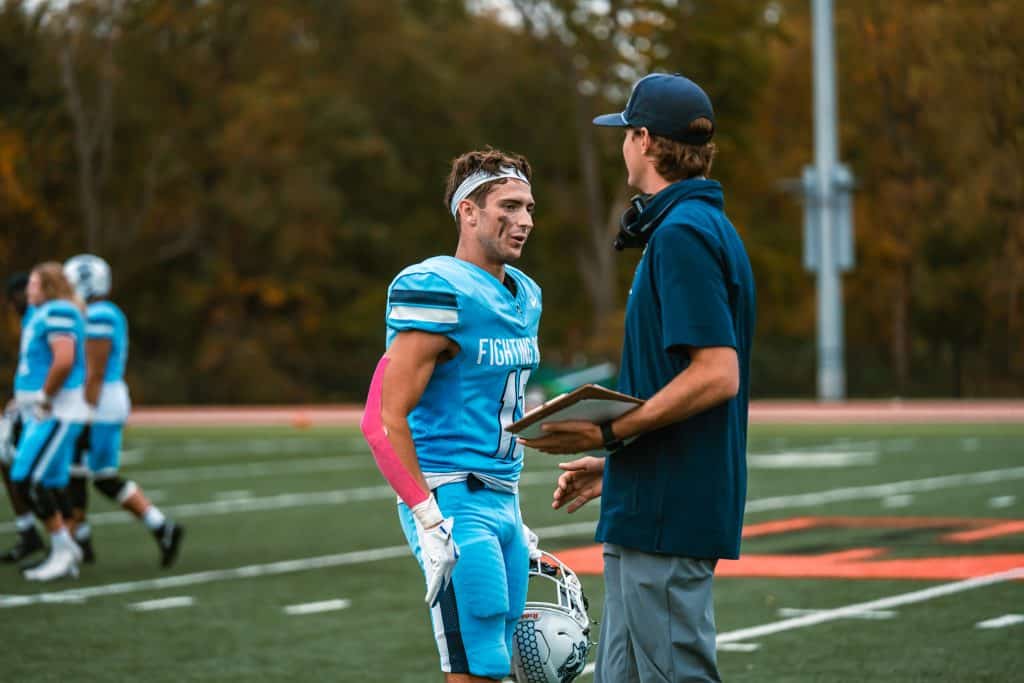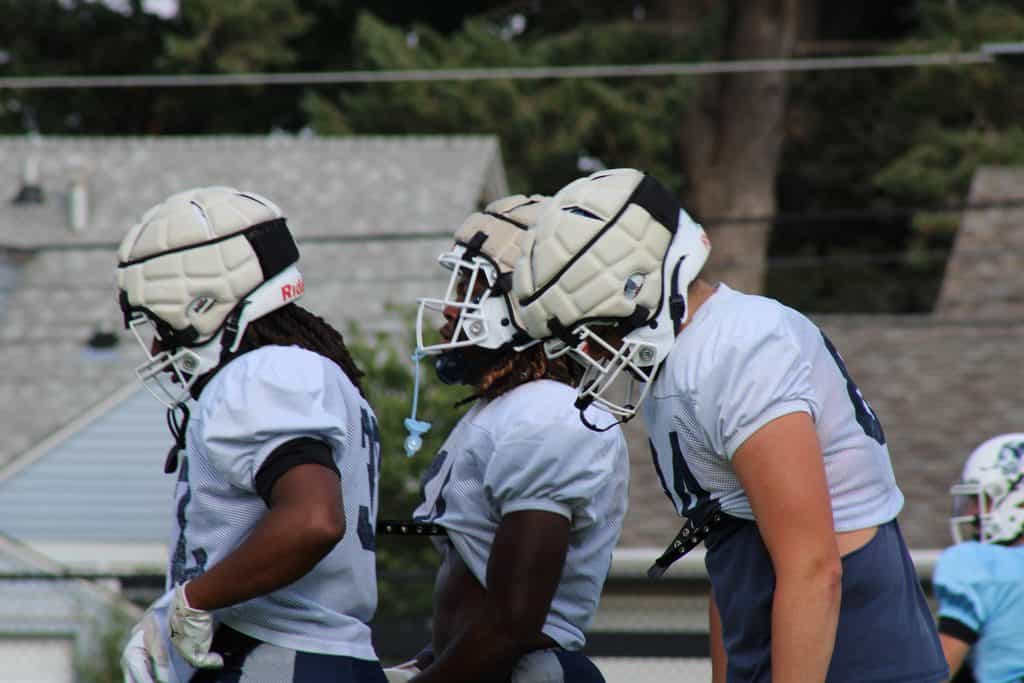
St. Ambrose Football Players wearing Guardian Caps. Photo Courtesy of Avery Lisk.
Coaches’ Perspectives
At St. Ambrose, football coach Bernard Buhake said player safety begins before athletes even step onto the field.
Buhake says, “Virginia Tech does a study where they test the impact on helmets. So, when we order helmets, we like light ones, though they are the best. We must work within our budget, so we have the second best. A lot of our guys say that they like the other ones, but they don’t protect their head as well.”
Buhake said the program also works with helmet manufacturers and athletic trainers. The aim is to help players understand how to use their equipment effectively.
Buhake says, “First we start with the helmets, and then when the helmet guy comes, he does training. He will talk about concussions, effects, and then how to help prevent concussions. He will also talk about how you fit the helmet.”
Trainers fit the helmets, and players complete concussion testing and safety procedures before returning to the field.
Buhake said coaches also emphasize proper tackling techniques and avoiding unnecessary use of the head during play.
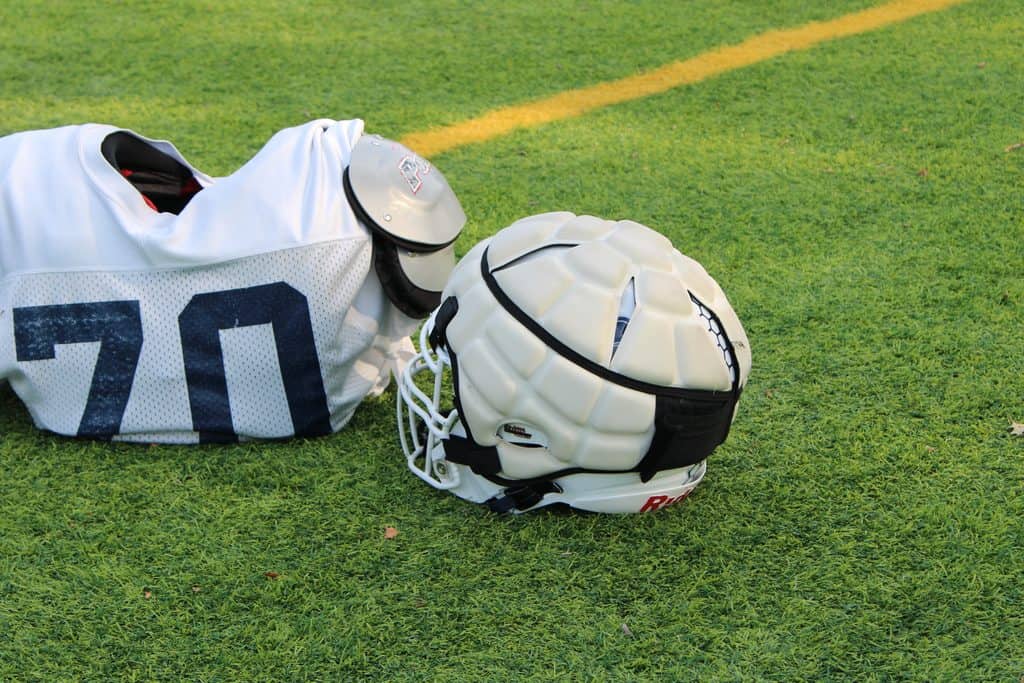
Another piece of equipment being used is the Guardian Cap, a padded covering worn over a football helmet. Buhake said the caps are particularly useful during practices for offensive and defensive linemen, who experience frequent contact.
“The Guardian Caps are basically just an extra layer, especially during practice,” Buhake says.
Players can also wear Guardian Caps during games, although Buhake said individual players decide whether they want to use them.
Players’ Perspectives
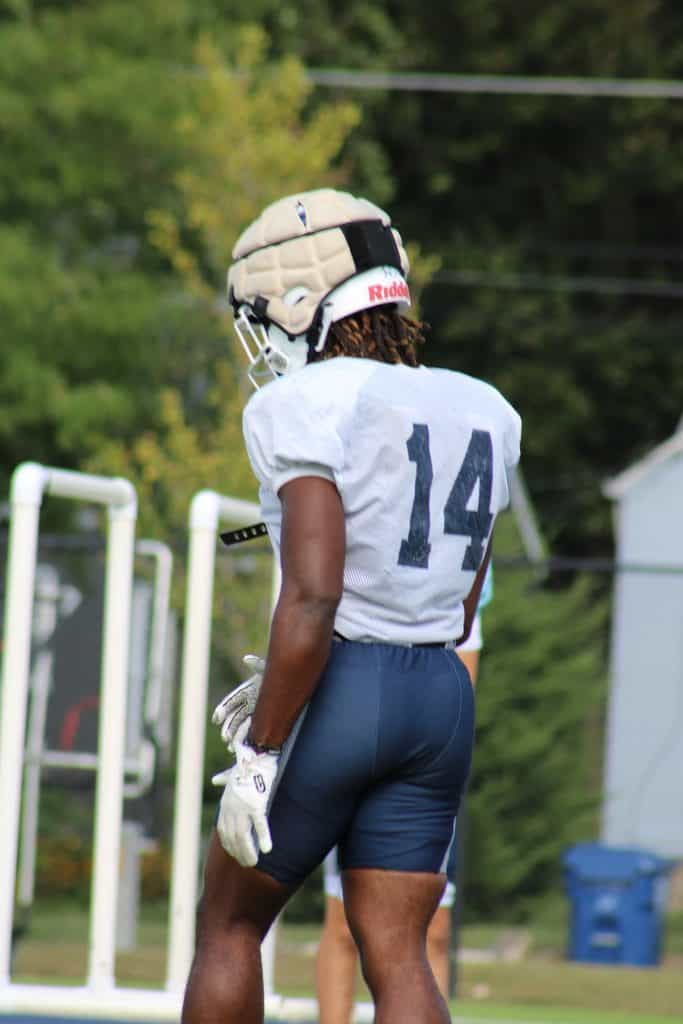
For players, the additional protection can change how they approach contact on the field.
Sophomore football player Shawn Harris said he noticed a difference after beginning to wear a Guardian Cap.
“When you’re hitting people with a Guardian Cap on, you don’t feel as much,” Harris said. “It’s like it softens the blow.”
Harris said the additional padding gives him another layer of protection against helmet-to-helmet contact.
“I will say that for sure, just from being a person that did not wear it to being a person that wears it now. It does change a lot personally,” Harris said.
Although Harris said the equipment makes him feel more comfortable with contact, he views it as an additional precaution rather than a reason to ignore the risks.
“Some games I feel like I wouldn’t be as scared to hit people because I wouldn’t be as scared to get a concussion,” Harris said. “But I am not scared to hit people now. It is just like that little extra precaution.”
Senior football player Kiylyn Black also said the purpose of the Guardian Cap is to provide additional protection.
“We wear our Guardian Caps to protect our heads from any kind of brain injury, brain bleeds, or concussions,” Black said.
The players’ experiences show how safety equipment can affect protection and how athletes feel about contact during the game.
Understanding CTE
As concerns about the long-term effects of football continue to grow, chronic traumatic encephalopathy, or CTE, has become an important concern for players, coaches, and parents.
CTE is a progressive neurological disease associated with repeated impacts on the head. It can be diagnosed only by examining brain tissue after death; researchers cannot determine whether a living person has CTE.
The New York Times did a study of former NFL players that renewed those concerns. Researchers examined the brains of the 235 former NFL players who died between 2016 and 2021, and 24.5 percent of those examined were found to have CTE. The study involved 878 players in total, but the brains of 643 were not examined.
While the findings do not mean that one in four of all 878 players had CTE, they highlight the concerns surrounding repeated head impacts in football.
Those concerns extend beyond professional football and into high school programs, where coaches are looking for ways to reduce the risk of concussions and other head injuries.
Parents’ Approach
For parents, however, the decision to allow their children to play football can be more complicated.
The recent research surrounding CTE has renewed concerns about whether the potential long-term risks of repeated head impacts outweigh the benefits of participating in the sport.
The Los Angeles Times released an article on a CTE study, renewing “parental concerns about teenagers playing football”. Writer Eric Sondheimer spoke to parents about their approach to letting their son or daughter play high school football.
Mike Hamilton, a former high school football and basketball coach whose son plays football at Chatsworth High, said he has experienced those concerns firsthand.
“Sometimes I am like, do I want him to play?’ I am apprehensive,” Hamilton said. “He has a passion for the game. He is conscious about his health.”
Hamilton said safety protocols have helped give him some reassurance. His family also made the decision not to let his son play football until high school because of concerns about the hits involved in the sport.
“What gives me relief is knowing that practice is going well,” Hamilton said. “There are protocols parents should abide by.”
At the high school level, rules requiring players to sit out for a minimum of seven days following a concussion, receive medical clearance before returning, and follow restrictions on tackling during practices are among the measures intended to reduce the risks associated with head injuries.
For parents, those precautions can shape the decision-making process: understanding the risks, asking how a program responds to concussions, and deciding what level of participation they are comfortable with.
As research into CTE grows, football programs are responding with equipment, testing, education, and changes to practices. But for coaches, players, and parents, the question remains how to balance the risks of repeated head impacts with the value athletes and families place on the sport.