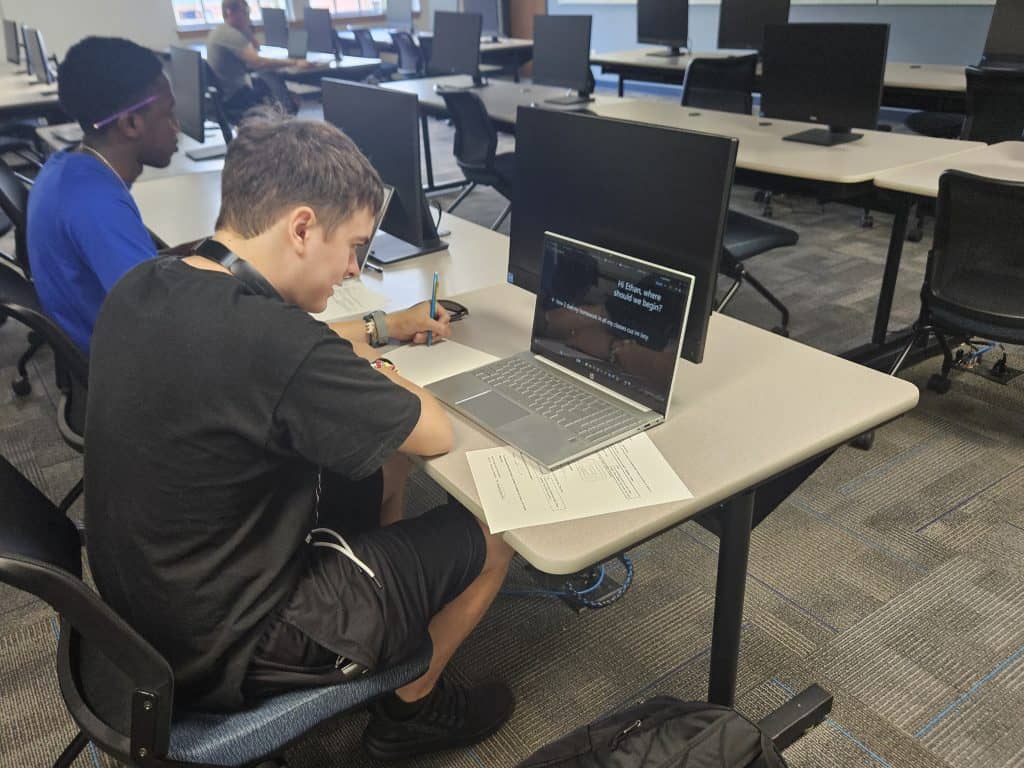
Above: Ethan Raeside is seen studying with the help of AI. Photo Courtesy of George Coin
Artificial intelligence has taken center stage on university campuses across the country. SAU computer science major, George Coin, begins a four-part series titled “AI at Ambrose” on how AI is challenging students and faculty. In his first segment, he explores how students are using AI in their studies and where they draw the line on cheating.
Chemistry notes become practice quizzes. Confusing code gets explained line by line. SAU students are increasingly turning to AI for help that is always at their fingertips, available whenever they need it. But as chatbots become study partners and writing assistants, students face a hard question: Is the tool helping them learn the content, or just making it easier to finish an assignment?
A New Kind of Study Partner
For sophomore exercise science major Jalyn Hawk, chemistry notes can become a study tool with the help of AI. “I use AI to make practice tests,” she says. She also asks it to explain background material in anatomy and physiology, especially when a difficult concept builds on something she is not familiar with.
Hawk says AI can answer a question when there is not time to ask it in class or attend office hours. But she has also seen it struggle with details such as significant figures in chemistry.
“You kind of have to do some double checking to make sure it all makes sense,” she says. Hawk, who also tutors, adds that AI does not replace asking a teacher or another person for help.
Junior computer science major Ethan Raeside says he also uses AI when an explanation has not clicked. A challenging textbook passage can be broken down into easier to grasp analogies and confusing code can be explained line by line.
“I understand the logic. I know exactly what I want this to do and how I want to do it,” he says. “I just don’t know how to translate it into computer speak.”
Having an answer immediately available has changed how long he is willing to stay stuck. “I could sit here and suffer at this … or I could just ask the AI and the AI could just tell me right now,” he says.
Getting an answer, though, does not always mean he could reach it on his own. To check his understanding, Raeside tries a related task independently. If AI helps him position text on a website, he can try moving it somewhere else without asking again.
Saving Time, Keeping Ownership
For junior psychology and theology double major Mallory Zeman, saving time matters in a schedule she says includes 18 credit hours, five jobs and multiple extracurricular activities.
“Sometimes we don’t use it because we want to, but rather because we have to, because of time,” she says.
Zeman uses AI to check grammar and clarity in writing she has already completed. An AI tutor has also helped her understand science concepts through analogies. Still, she has reduced her use after recognizing how much she was relying on it.
“I’m relying on this way too much, and I need to use my own ideas rather than make this do all the work for me,” she says, recalling that realization. “And I do think some struggle is good when it comes to academics.”
Zeman would like to see clearer AI policies across classes, especially when students share responsibility for an assignment. She says she rewrote a classmate’s contribution after concluding it was AI-generated, which could have put her own grade at jeopardy. “It’s stressful, especially when you’re putting in the work and others are not,” she says.
That uncertainty extends beyond SAU. According to The New York Times, many universities leave decisions about acceptable AI use to individual instructors, leaving students to navigate expectations that can change from one classroom to the next.
For senior mechanical engineering major Alex Huntley, deciding when to use AI also means weighing how much he has tried on his own. He recalls turning to AI during a mechatronics lab after spending five or six hours trying to get a robot’s vacuum and movement functions working together. He had already asked other people for help.
“I don’t like to outsource my thinking,” Huntley says. “It’s kind of dumb to go to class and then have a computer tell me what the answer is. I’m supposed to figure it out myself.”
Learning Beyond the Answer
That concern is familiar to philosophy and critical thinking professor Tanya Randal, co-leader of SAU’s AI Institute, which trains faculty to discuss AI use with students and explore ways to support learning with the technology. Randal says its focus is faculty education rather than setting university policy.
She piloted a chatbot in one of her philosophy classes aptly named “Socrates Bot” to help students develop their ideas through dialogue. Instead, she says some students would merely copy its questions into ChatGPT and paste the answers back.
AI was answering AI, with the student serving as the messenger between two chatbots. An assignment meant to exercise critical thinking had become an exercise in copying and pasting.
“What we want to teach is the process of thinking, and I’m not looking for a specific answer,” Randal says. By outsourcing that thinking, students miss the practice of building an argument and explaining why it makes sense. For Randal, the test is whether they can explain or teach the material afterward without AI.
Samantha Dunn, SAU’s director of learning, who co-leads the AI institute with Tanya, says she worries that following an explanation can feel like understanding without the ability to produce a solution independently. “Studying a problem and working through a problem are two different cognitive skills,” she says.
Asked about replacing a lengthy assigned reading with an AI summary, Dunn is blunt: “Complete the assigned reading. Just do it.”
Dunn’s distinction echoes concerns extending beyond SAU. An MIT committee warned that students who reach for AI “at the first hint of struggle” can experience “the illusion of learning,” according to The New York Times.
A chatbot’s explanation may feel clear in the moment, but following its reasoning does not necessarily prepare students to solve a similar problem independently. When AI takes over that process, students risk completing the assignment without developing the skills it was designed to teach.
She encourages students to talk with professors, check course expectations and disclose their use. “When we use AI as an assistant, we are still highlighting who we are as individuals,” she says.
SAU professor of computer and information sciences Travis Eygabroad says he sees value in immediate clarification and feedback on work students have attempted. His concern is an answer they cannot explain. Even debugging code requires understanding the correction to avoid repeating the mistake.
Before using AI, he wants students to ask: “Am I still going to learn what I need to learn if I use AI?”
The Hidden Cost of Convenience
For these students, AI can be a study partner, an editor or a last resort. The benefits are clear: explanations, quick feedback and time for other responsibilities. The costs are less visible.
A correct answer can hide a gap in understanding, and a finished assignment can conceal practice skipped along the way. AI can make schoolwork easier to finish, but the value of an education lies in what students take with them. The challenge for SAU students is to leave with more than completed assignments. They need skills and confidence they can carry with them beyond the classroom.
In the October Buzz issue, George will explore faculty perspectives on AI and how it is changing the way they teach, design assignments and assess student learning.