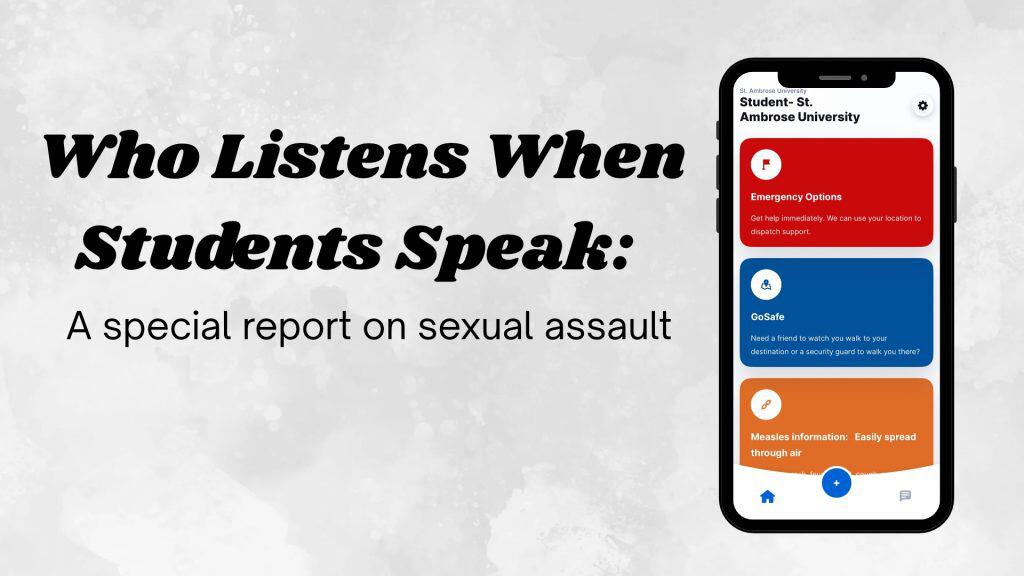
Students can use the LiveSafe app to contact first responders or campus security immediately. Graphic Courtesy of Sophie Schillie
Campus safety involves more than responding to an immediate threat. It also means ensuring students know where to turn after a sexual assault—and what happens when they ask for help.
As part of The Buzz’s special report on the sexual assault allegations at Cornell University and campus safety at St. Ambrose University, university officials explain SAU’s reporting process and the support available to students.
“Supportive measures include, but are not limited to: counseling services, chaplain referrals, no-contact directives, housing adjustments, academic accommodations, etc. These are available with or without a formal investigation,” says Kylie Kuffler, Director of University Compliance and Title IX coordinator.
If a student reports a sexual assault, the Title IX coordinator or another designated campus official reviews the information, addresses immediate safety concerns, and explains available resources and options. Kuffler says students do not need to have decided whether to pursue a formal complaint before seeking support.
“You do not have to know exactly what you want to do before reaching out for support,” affirms Christopher Waugh, Vice President for Student Life and Dean of Students.
Students who report a sexual assault at St. Ambrose University can receive support without pursuing a formal investigation, according to university officials.
The Buzz asked how many sexual assault reports have led to formal investigations on campus from 2021–2025. Kuffler explains that, “SAU does not publicly publish annual statistics showing how many sexual assault reports resulted in formal Title IX investigations or the outcomes of those investigations.
“However, the University publishes its Title IX policies and Clery Act crime statistics here: Title IX | St. Ambrose University and 2025 Security Report and Fire Safety Report (2024 Data) | St. Ambrose University.
The Buzz has also asked campus security for any information regarding sexual assault incidents or prevalence on campus, but the office was unable to respond in time for publication. If The Buzz receives information from campus security, this story will be updated.
What happens if a report is filed
After a student reports a sexual assault, the Title IX coordinator or another designated campus official reviews the information, addresses immediate safety concerns, and explains available resources and options, Kuffler says.
Making a report is different from requesting a formal investigation. While deciding how they want to proceed, students can request counseling referrals, housing adjustments, academic accommodations, and no-contact directives.
“These are available with or without a formal investigation,” she adds.
Waugh also says the Dean of Students Office helps connect students with the Title IX coordinator, counseling services, campus ministry, and other support services. His office also works with campus partners to arrange adjustments based on a student’s needs.
“We recognize that timely support matters, and we work to address requests promptly and on an individualized basis,” he says.
Kuffler adds the university may proceed without a student’s participation in limited circumstances, such as an ongoing threat to campus safety, “that would be when the university has the responsibility to protect the broader campus community.”
Survivor Services
Waugh says the service formerly known as “Safe Path” is now called “Survivor Services.” It is provided through Family Resources, a local outside agency with a longstanding relationship with SAU.
SAU’s Counseling Center hosts a Family Resources survivor advocate on campus every Friday, Waugh explains. Students can also find the service’s telephone number on the back of their BeeCard or connect through campus support offices.
“Students can reach out to explore available services and discuss their options, even if they are uncertain about what steps they want to take.”
The Dean of Students Office does not track how many students use Survivor Services after receiving a referral, according to Waugh. He says Family Resources would need to be consulted about whether aggregate usage information is available.
Reporting responsibilities and investigations
Kuffler explains that faculty, staff, and resident assistants are generally required to report information about sexual misconduct to the Title IX coordinator or designated office. She separately identifies confidential resources students can approach for support.
Mandatory reporters must share known details, including the people involved, the nature of the incident, and available information about when and where it occurred, Kuffler says. Reports should be made promptly, generally within 24 hours or by the next business day.
“If a case moves into a formal investigation, trained investigators gather evidence and interview the reporting person, the accused person, and relevant witnesses,” Kuffler says. Evidence may include documents, messages, photographs, or videos.
Both parties can present evidence, identify witnesses, and have an adviser of their choice, Kuffler explains. They also receive information about the outcome and any available appeal rights.
Possible outcomes include disciplinary sanctions and measures intended to support the affected student. Kuffler says SAU prohibits retaliation against people who report misconduct or participate in an investigation.
“Most importantly, students deserve to be heard, treated with dignity, and supported without feeling that they must navigate these circumstances alone.”–Dean of Students
Dean Waugh also explains, “SAU partners with Third Millennium to provide online educational modules for first-year students addressing sexual violence prevention and alcohol and other drugs. These modules provide an important foundation for student awareness and prevention education.”
“The university tracks completion through an online dashboard and sends reminders to students who have not completed the modules,” Waugh says.
Waugh also says SAU is also working to expand bystander intervention training during the current academic year, including efforts focused on first-year students and athletic teams.
Residence Life staff already receives bystander intervention training and participates in “Behind Closed Doors,” a scenario-based program that uses role-playing to prepare them for situations involving sexual assault, alcohol and drugs, and other student concerns, according to Waugh.
“We want our residence life staff to be equipped to respond appropriately, connect students with resources, and understand when and how concerns must be reported.”
Education continues beyond students’ first year through campus programming and resources.
“We recognize that prevention is an ongoing responsibility, not a one-time training,” he emphasizes.
For students who have experienced sexual assault, Waugh says reaching out can begin with a conversation rather than a decision about a formal report.
“Most importantly, students deserve to be heard, treated with dignity, and supported without feeling that they must navigate these circumstances alone.”
For more information on SAU’s policy, see the Title IX page on sau.edu