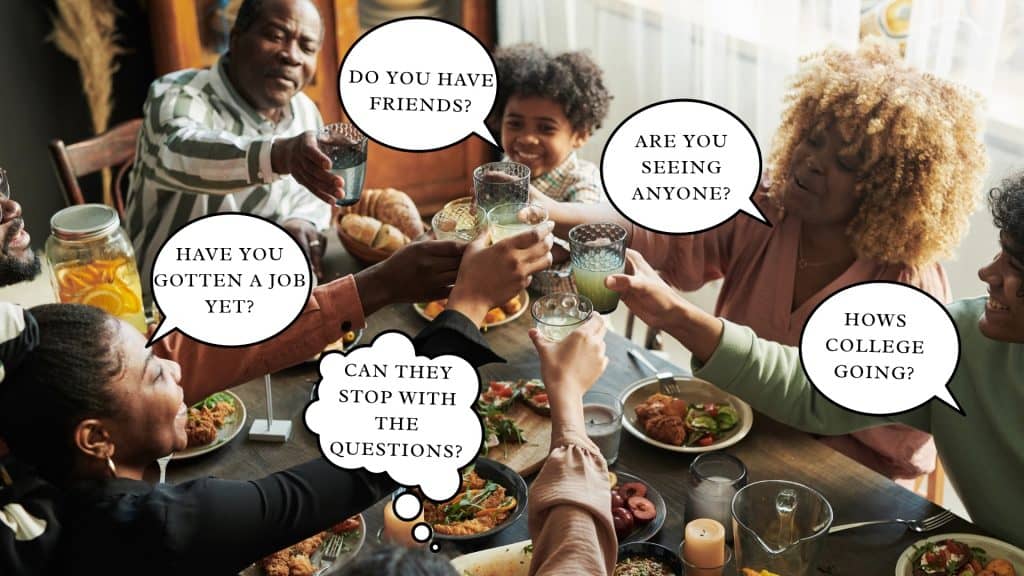
The Classic chaotic dinner table. Graphic Courtesy of Sophie Schilllie
Article by Olha Slobodianiuk, BuzzStaff Writer
Thanksgiving is supposed to be a time for good food, family, and gratitude. But for St. Ambrose University students returning home for the holiday, it can also mean answering uncomfortable questions, defending personal decisions, and listening to relatives share personal and political opinions nobody asked for.
For sophomore graphic design major Riley Miller, one of the most uncomfortable questions from relatives is a familiar one.
“Probably asking when I am gonna get married, and if I have a boyfriend yet,” Miller says.
From questions about relationships and future plans to unexpected political debates around the dinner table, family gatherings can sometimes become more stressful than relaxing.
Sophomore biology major and chemistry minor Anna George has her own way of handling unwanted comments, silently asking her mom for backup.
“I’ll just look at my mom and be like, ‘Did you see that?’” George says.
Sometimes, avoiding the conversation altogether is the easiest option. Freshman elementary education major Vanessa Mendoza said she tends to stay quiet during disagreements.
“With my family I think I tend to avoid conversations because a lot of the time, they won’t stand down, like they are always right,” Mendoza says.
Anna George takes an even simpler approach. “I just kind of sit there and prioritize eating my food,” she says.
While ignoring uncomfortable comments might seem like the easiest way to keep the peace, family tension during the holidays is not unusual, according to Amber Dopler, a counselor and mental health outreach and prevention specialist at the St. Ambrose Counseling Center.
Dopler explains that family relationships can bring out stronger emotional reactions because families play such a significant role in shaping a person’s identity.
“Families are complex systems in which a large part of our identity is formed,” Dopler says. “For that reason, we may be more emotionally reactive in our family systems than in other areas of our lives.”
Social media can also contribute to tension. Family members may feel like they know what is happening in each other’s lives based on what they see online, even when they have not had meaningful conversations in months. Those assumptions can create uncomfortable interactions when relatives finally meet face-to-face.
For college students, these interactions can be especially challenging. Dopler says college is a time when students naturally begin questioning family values and beliefs while developing their own identities.
Questions about grades, majors, relationships and future plans may come from a place of love or concern, but relatives may not realize how their comments affect students already navigating the pressures of college.
So, how should students handle an uncomfortable conversation?
Dopler says there is no single correct way to respond to family conflict. “If you choose to ignore uncomfortable comments, it’s important to understand how they still impact you,” she says.
Preparing ahead of time can also help. Dopler suggests identifying emotional triggers, finding a trusted family member for support and having a plan to step away when conversations become overwhelming. Taking a walk or getting some space can prevent a disagreement from escalating.
Dopler also encourages students to practice self-awareness by recognizing when relatives’ comments affect their self-worth or personal beliefs, while choosing which disagreements are worth addressing rather than focusing on proving someone wrong. “Address them because they matter to you, not because you are trying to convince anyone you are right,” she says.
She also advises students to approach disagreements with curiosity rather than immediately preparing an argument. Listening to a relative’s perspective does not mean agreeing with them.
Setting boundaries is equally important. “Recognizing that our value and worth is not tied to the real or perceived criticisms of others is a huge step toward emotional maturity,” she says.
Dopler also reminds students that family members may express love differently, even if the way they communicate it doesn’t fully align with what students need or expect.
However, knowing when to step away can be one of the hardest, yet most important, parts of handling difficult family relationships.
“I think it’s important to do what you can, and if it doesn’t go through, then prioritize yourself and get away from those people or like distance yourself,” Mendoza says.
Other students emphasize finding a balance between maintaining relationships and standing up for personal beliefs.
“Be patient, know your boundaries, but also stand up for what you believe in. You can do that while being respectful,” says junior psychology major Sophia Roskowski.
Graphic designer sophomore Riley Miller also encourages students not to spend too much time worrying about relatives’ opinions, especially those they only see occasionally.
“Don’t overthink it because at the end of the day it’s a matter of whether or not and how much you care about their opinion,” Miller says.
Thanksgiving does not have to be perfect, and neither do family relationships. Whether students choose to laugh off an awkward question, change the subject or take a break from the dinner table, protecting their peace matters.
After all, there’s only so much turkey one can eat before the conversation turns uncomfortable.