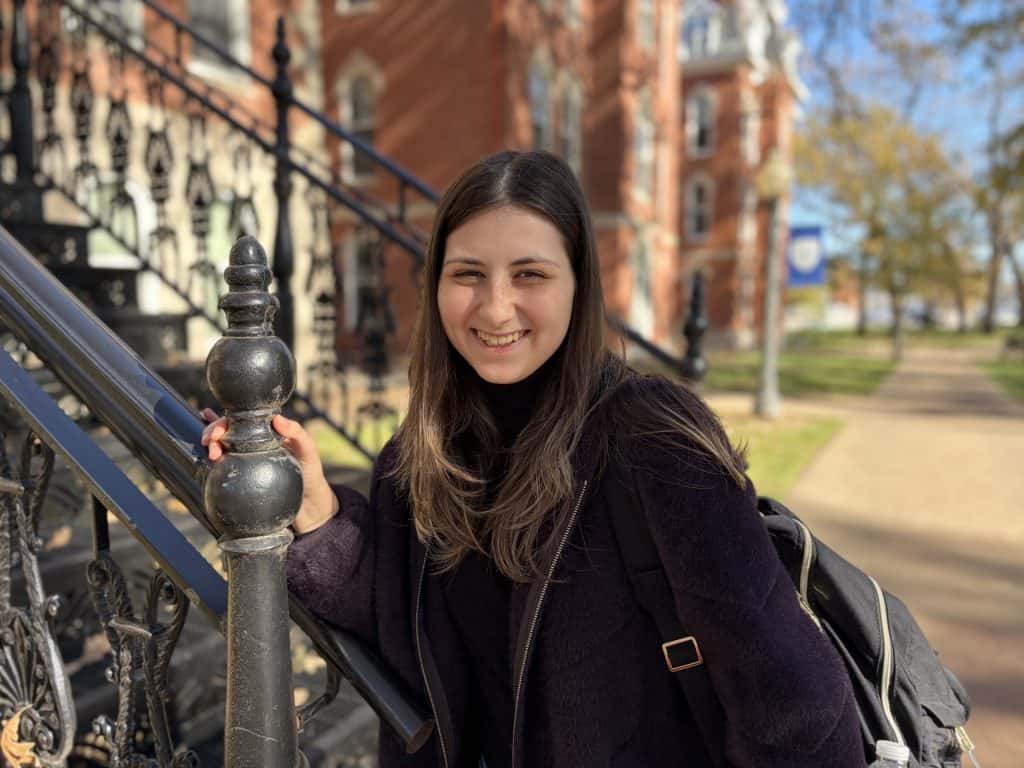
Olha standing in front of Ambrose Hall. Photo Courtesy of Olha Slobodianiuk
Article by Devin Richards, BuzzStafff Writer
Moving to a new country can be a difficult experience for anyone, but for sophomore Public Relations major Olha Slobodianiuk, living in the United States means more than adjusting to a new culture. It means leaving behind family, friends and the life she had always known while the war with Russia continues in her home country.
With her parents still living in Ukraine, Olha constantly worries about their safety. The eight-hour time difference makes communication difficult, and she knows that conditions can change at any moment.
During a visit home this past summer, Olha experienced the reality of living in a country at war.
“The sirens are just every day, all the time. The bombs are every day, all the time. You just don’t know what’s gonna happen.”
“It affects basically everything.”
The war has also created financial challenges for her family. Her parents are unemployed as limited job opportunities and financial instability plague Ukraine. Olha is unsure whether she will be able to continue her education in the United States.
“I’m not sure I’m gonna be able to continue education here soon because my parents just don’t have enough money,” Olha says.
Now in her fifth year living in the U.S, Olha has experienced the differences between American and Ukrainian culture while continuing to worry about her family back home.
Although moving to a different country might seem overwhelming, Olha says adjusting to American culture was not as difficult as she originally expected.
“It wasn’t that hard for me. I was just feeling like I’m coming to a place from the movies.”
Growing up watching American movies like “Home Alone” and experiencing American culture through the Internet helped prepare her for what life in the U.S would be like. However, she quickly discovered that there were still major differences between the two countries.
According to her, Americans tend to be more welcoming and willing to help strangers, while people in Ukraine are generally more reserved.
“People here are a lot more friendlier and a lot more open,” Olha says. “Like you have an issue, have a problem, they’re gonna help you.”
Olha explains that something as simple as smiling at a stranger can be viewed differently in Ukraine: While Americans often smile or greet people they do not know, that behavior is not as common in her home country.
Another difference Olha noticed was the food. Traditional Ukrainian dishes, such as buckwheat porridge and different types of soup, are much more common back home. She also expressed surprise at certain American Thanksgiving dishes, especially sweet potatoes with marshmallows.
Although she enjoys both foods separately, Olha does not believe they belong together.
“I love sweet potatoes, and I love marshmallows, but they don’t belong together.”
After trying the dish herself, Olha said she did not like the combination.
Despite these cultural differences, Olha believes there are several things Ukraine does better than the United States, including public transportation and technology.
She explains that Ukraine has a government application that allows citizens to access important documents and services, including passports, driver’s licenses and other government information all in one place.
Public transportation is another area where Olha believes Ukraine has an advantage. She can select from several different public transportation options available within minutes, something she has not always experienced here in the Quad Cities.
Her journey to the U.S has been far from simple. After the war began, Olha had to travel outside Ukraine to apply for a student visa because the process could not be completed in her home country.
She first traveled to Budapest, Hungary, while attempting to obtain a visa for the United Kingdom. When that plan did not work out, Olha returned to Ukraine before beginning the process of obtaining a U.S student visa.
After completing paperwork, interviews and weeks of waiting, Olha eventually received approval to travel to America. She then traveled by bus to Germany before boarding a flight to the U.S.
Her original plan had never been to attend college in America. Olha’s mother had envisioned her completing a bachelor’s degree in Ukraine before pursuing a master’s degree in Germany. However, the war forced her family to change those plans.
With a distant aunt living in North Carolina, the U.S became the safest available option her family could arrange.
Since arriving, Olha has lived in North Carolina, Chicago, and the Davenport area, experiencing different parts of American life and education along the way.
At St. Ambrose University, Olha has developed an interest in working in public relations.
“I don’t know, but probably working in social media,” Olha says.
However, her future remains uncertain because she does not know whether she will be able to stay in the United States to finish college because her family doesn’t have the money for her to stay.
“I’m just seeing how everything unfolds,” Olha says. “I will see if I’m going to be able to stay in the U.S. or if I’ll have to go back home.”