(Photo courtesy of Dora De La Cruz)
The 2024 presidential election has proven to be significant for university students, as it touches on issues that directly impact their futures such as immigration, women’s rights, and the economy. St. Ambrose University has student-run clubs representing each party, the College Democrats and College Republicans.
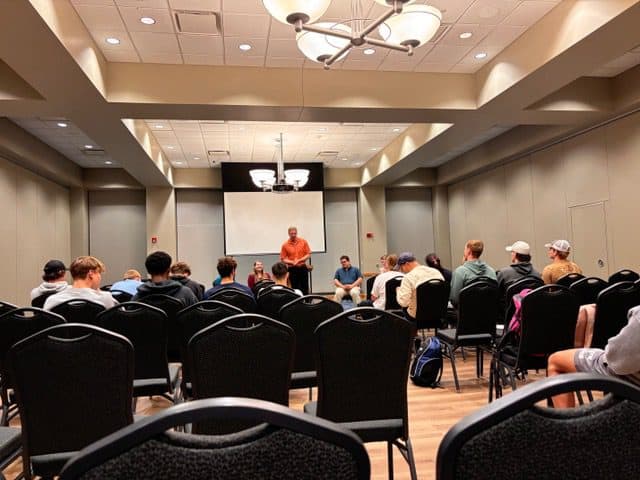
A lively watch party was held on Tuesday, October 1, in anticipation of the first Vice Presidential debate between Democratic VP nominee Tim Walz and Republican VP nominee JD Vance. The watch party took place in the Rogalski Center on campus.
Prior to the televised debate, students were invited to watch a student debate as members of the College Democrats and College Republicans clubs faced off on key issues. Organizers say,this pre-debate event encouraged students to hear diverse political perspectives and set the stage for an evening of thoughtful debate and civic engagement.
After the student debate took place, the audience expressed strong opinions about what side made better arguments. Many, like Sophia Holthaus, believed the Democratic side stood out, particularly because they “had more evidence to support their claims” and “responded well to the other side.” Holthaus says she felt that the Republicans, on the other hand, seemed to “repeat what the Democrats had already said,” which she says weakened their stance.
This sentiment was also echoed by Kalea Dostal, who pointed out that the “Democrats brought a lot more different ideas and evidence to the table, while the Republicans appeared to contradict themselves at times.”
SAU senior Micheal Tappa also says he leaned toward the Democrats, expressing “…that they seemed more prepared. The second debater for the Republican side was a little less informed.”
However, not all opinions were entirely one-sided. Erik Koopmann, despite identifying as a Republican, admitted that the Democrats “seemed more prepared” and says he felt the Republicans “could have answered things a bit differently.” Still, he says appreciated that both sides “remained professional throughout the debate.”
SAU political science professor, Dr. Kim, says he recognizes the professionalism of the student debaters, stating that they “handled it in a professional manner… focusing on the issues without becoming overly sensitive about the topics.” Despite the varying opinions, the debate showcased a respectful exchange of ideas and left many students impressed by the depth of discussion.
Organizers say events like the debate watch party and student debates at St. Ambrose University is vital for fostering political awareness and civic engagement among students. Participation in debates encourages students to become well-informed and engaged citizens, equipping them to contribute meaningfully to societal discussions both in college and later in life.
Dora De La Cruz is a staff writer for the Buzz.